
Police Greys and Royal Tours to W.A.

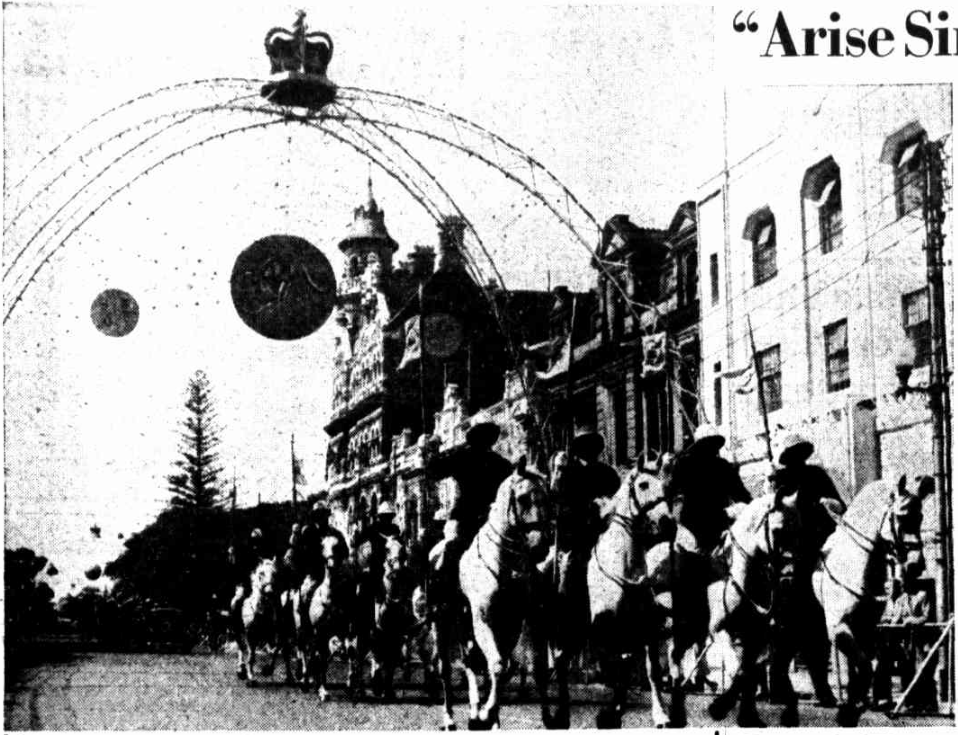
Waler Data Base @ Facebook. Image: Full Dress Rehearsal for Royal Visit, West Australian, 22nd March 1954
Queen Elizabeth the Second was crowned in June 1953. She was very responsible regarding her duties – touring the colonies was one. Royal feeling ran high, and the fact she and the Prince were horse lovers and went out of their way to save rare breeds of horse and pony, endeared them to many of us, republican or not.
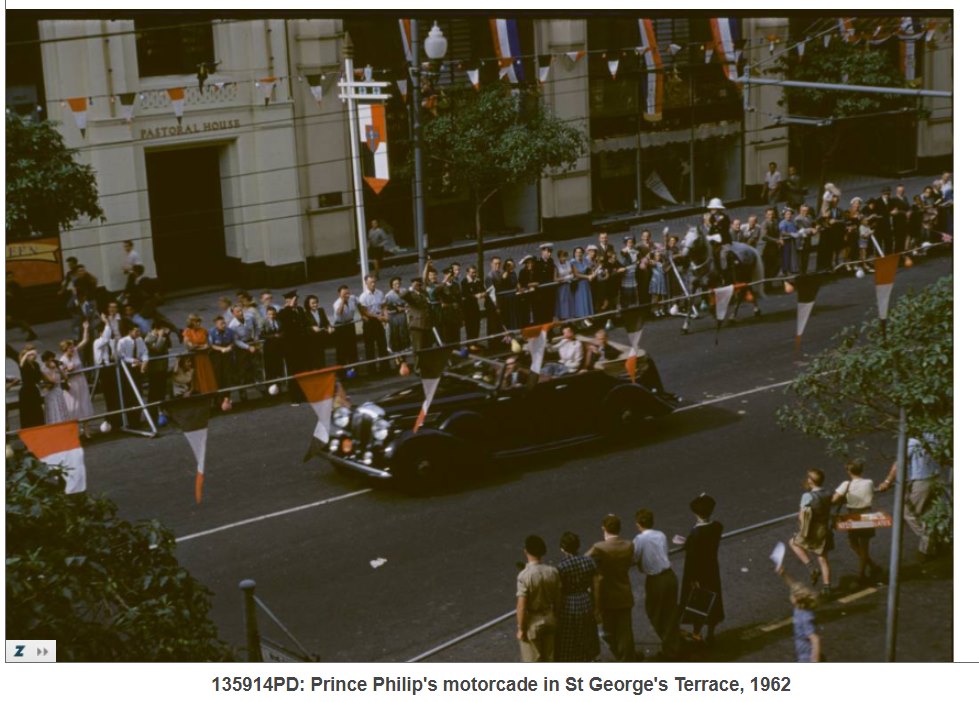
The full dress rehearsal for their 1954 tour to W.A included the car to be used by the Royals, and was under the arches put up for them. The actual royal progress along the streets of Perth lasted 65minutes, to enable crowds to get a chance of seeing them. Police horses went before and after their car to entire way.
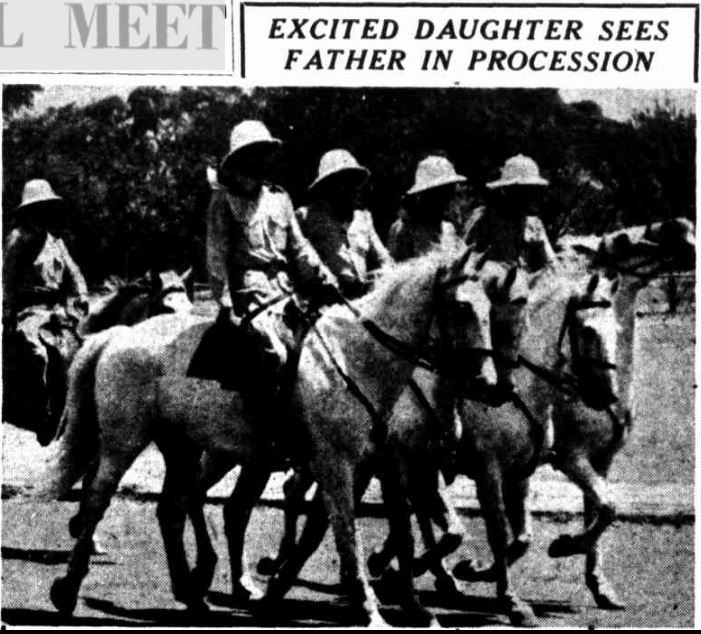
Rehearsal in the city for Royal tour duties.
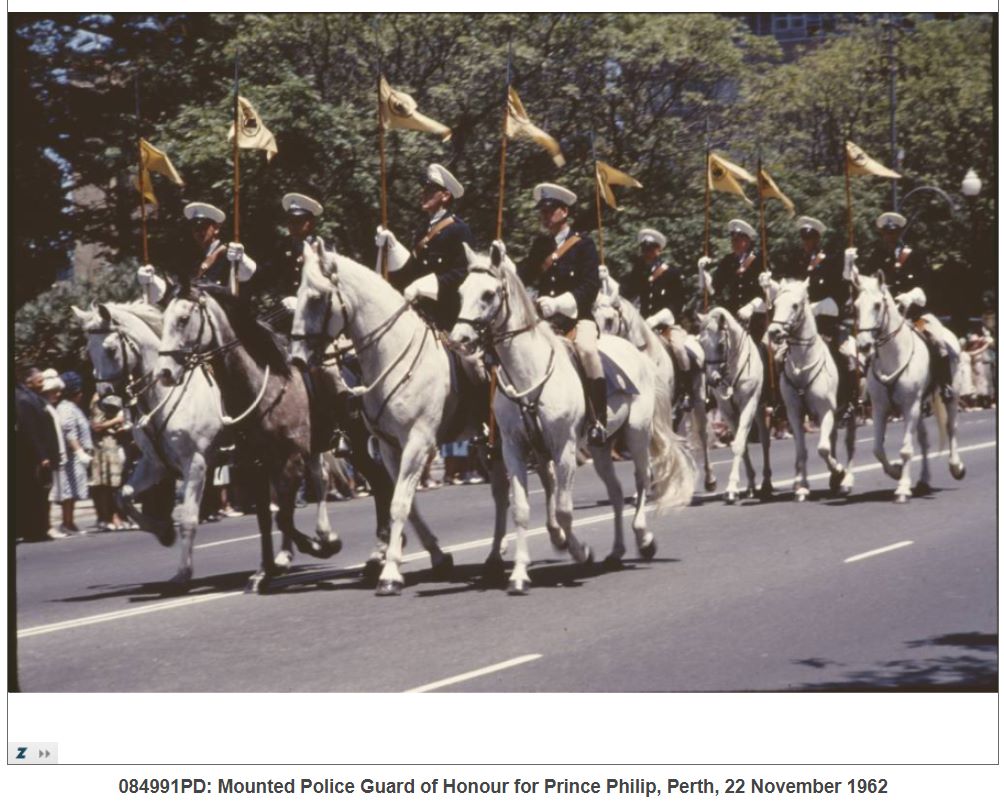
The escort in W.A. were the mounted police, and they did a truly amazing job. Some on motorcycle, but all eyes were on those on their famous grey horses – chosen because of the Windsor greys by Constable Street, and what a great horseman he was; and also read right below about Quarry Dust, one of the mounts used. W.A. was rightly proud of their state bred and trained horses.
Some went in front of the Royal car and some behind. Six miles an hour was the designated speed. The speed of a walking horse has always been the best for formal parades as it brings it to a human level. People can see what is happening and feel a part of it.
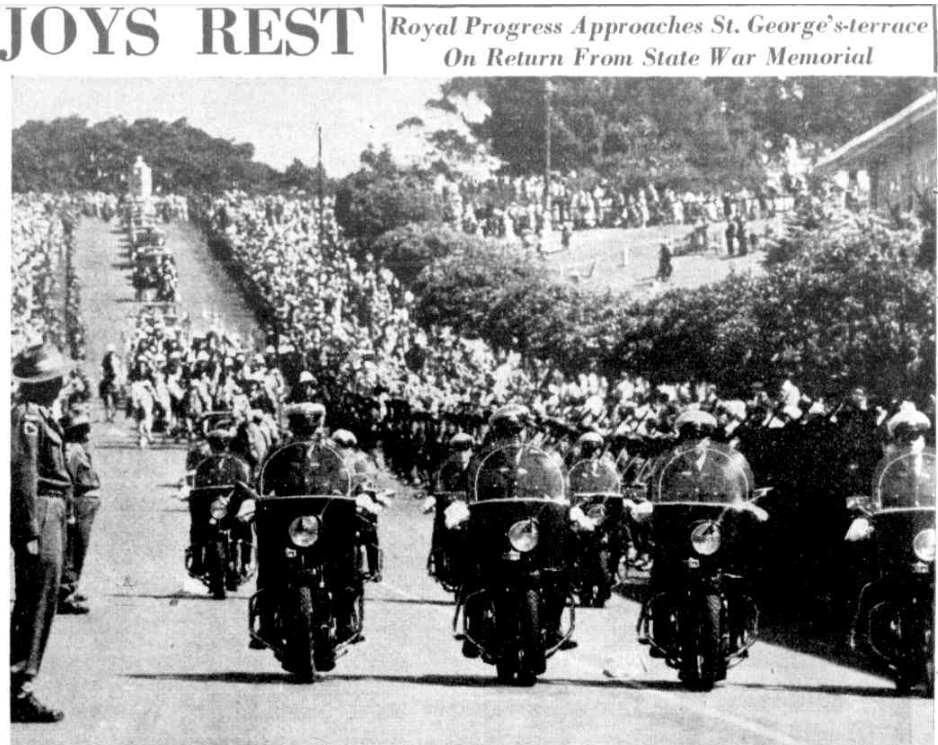
As well as simply looking good, putting up with cheering crowds, waving flags, tolling church bells and P.A. systems, the police were also on the lookout for anything that may occur affect the safety of the Royals and the public – not long before, in London, barriers broke under the huge crowd straining to see Her Majesty – mounted police there had to gallop back to stop crowds trampling each other, and impeding the Royal progress.
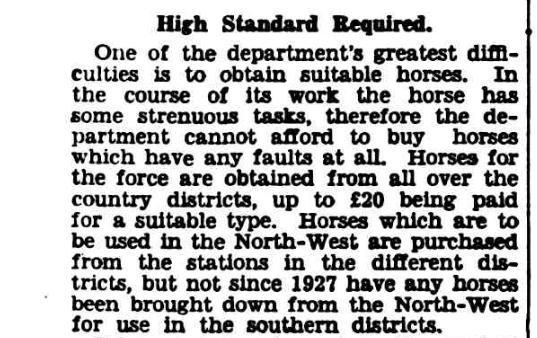
Image: West Australian, 14th September 1935.
For the first time since 1927, station horses from up north were selected for police horses to boost numbers for the Royal Tour.
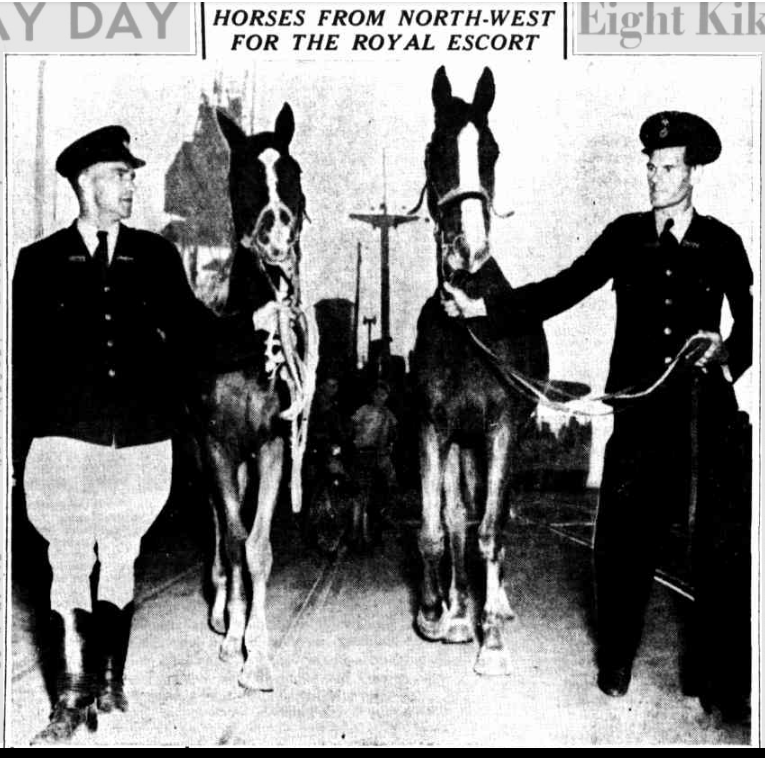
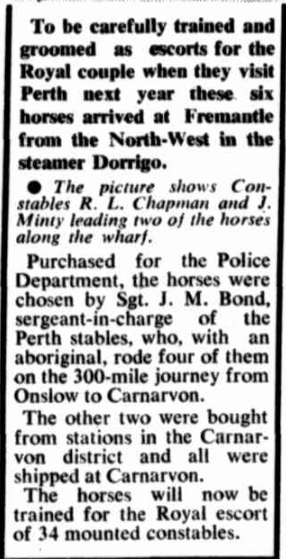
Images: West Australian, 2nd March 1953.
The Queen knew how well-trained police horses were and had a special love for them – after all they did their duty as she did, under many of the same conditions. For Trooping The Colour ceremonies in London, she always rode her favorite, sidesaddle – the chestnut police horse named Winston. Her husband the Duke of Edinburgh and her uncle the Duke of Gloucester rode grey police horses at these special events. By the time the Queen was crowned, Winston was getting old and sometimes nodded off to sleep while standing to attention.
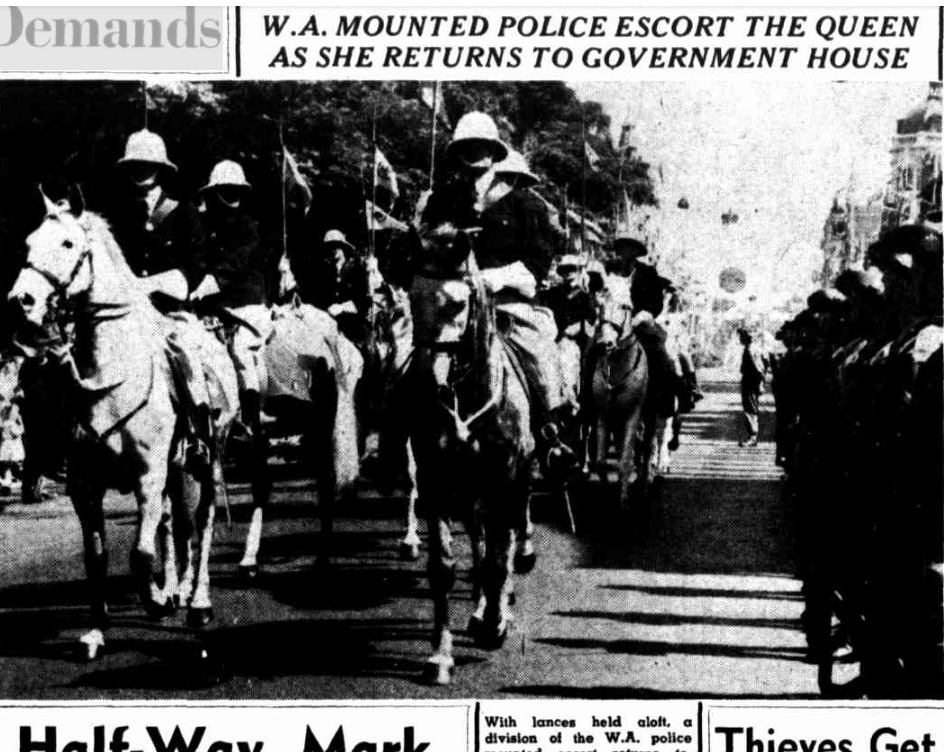
While in Victoria on this tour, Her Majesty took a little time out to go on a private bush ride -on a police horse.
It was a busy time in WA with visits to the capital and many other towns including Busselton, Albany, Northam, York, Kalgoorlie. Despite rain in some places, they toured in an open car so as not to disappoint the many children turned out to see them.
Thirty feet distances were maintained between groups of children and adults, to cut down risk of polio transmission.
The Royals even went to Gloucester Park to watch the trots, some 35,000 people turning up to watch them!
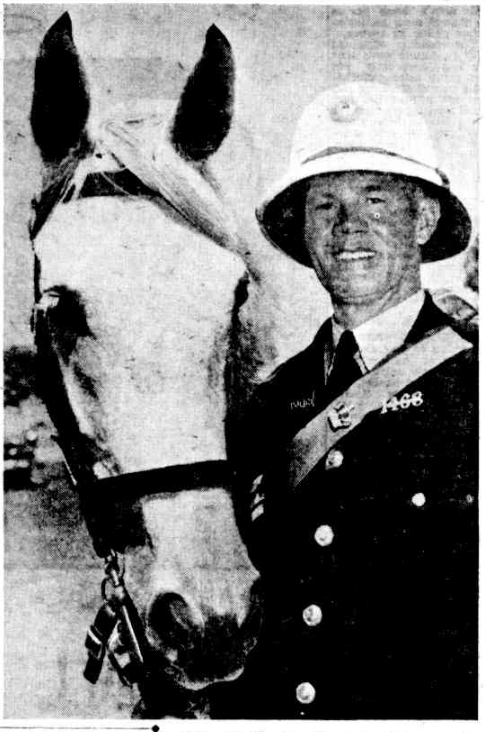
Image: Sunday Times, 25th February 1954.
Sergeant Jack Bond was in charge of the mounted procession, he had also taken over as police horse buyer and had selected which horses were used, both from existing mounts and ones bought in. He did very well. He’d spent a lot of time in the north, so knew where to find good horses.
The mounted police, Sergeant J. Bond, did such a good job, their leader was awarded The Royal Victorian Medal – as well as the leader of the motorcycle police, Sergeant Les Watts (previously a mounted policeman on horses). Both also got an autographed photo of the Royal couple.
The mounted police in all our states acquitted themselves exceedingly well during the Royal tour of 1953-4. Well done.
Other Royal visits to Western Australia featuring the mounted grey police horses.
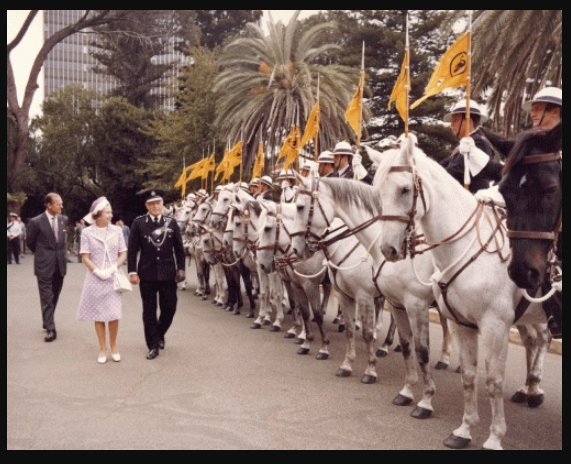
‘Queen Elizabeth II and the Duke of Edinburgh inspecting a row of mounted police in Perth, Western Australia, accompanied by the Police Commissioner of Western Australia Owen Leitch. Taken during the Queen and Duke’s 1977 official visit to Australia.
Inscription: In an album labelled “Visit to Australia of Her Majesty The Queen and His Royal Highness The Duke of Edinburgh, 7 March to 30 March 1977”.’
Uni of Melbourne.
‘Queen Elizabeth II patting a police horse while inspecting a row of mounted police in Perth, Western Australia, accompanied by the Police Commissioner of Western Australia Owen Leitch. Taken during the Queen’s 1977 official visit to Australia.
Inscription: In an album labelled “Visit to Australia of Her Majesty The Queen and His Royal Highness The Duke of Edinburgh, 7 March to 30 March 1977”.’
Uni of Melbourne.
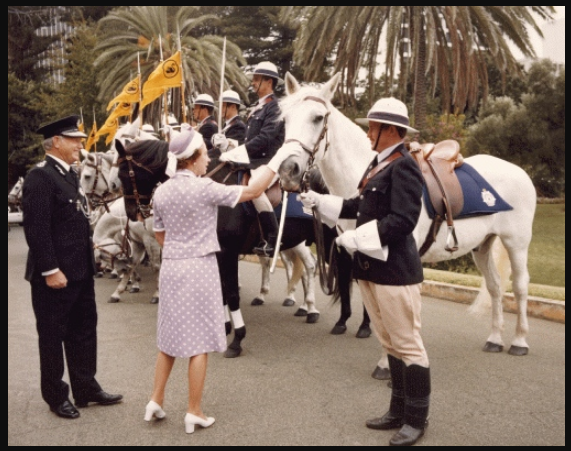
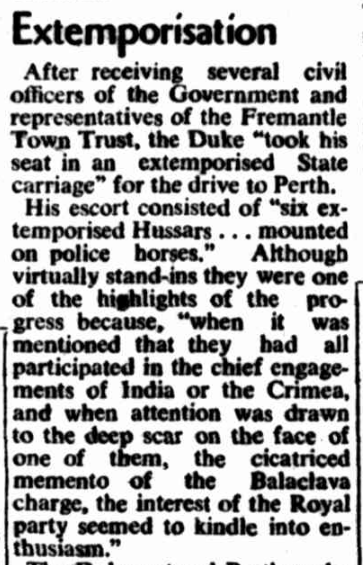
Image: West Australian, 10th March 1954.
Royal tour in 1862 – W.A. had very little notice of a surprise visit by Prince Alfred, the Duke of Edinburgh.
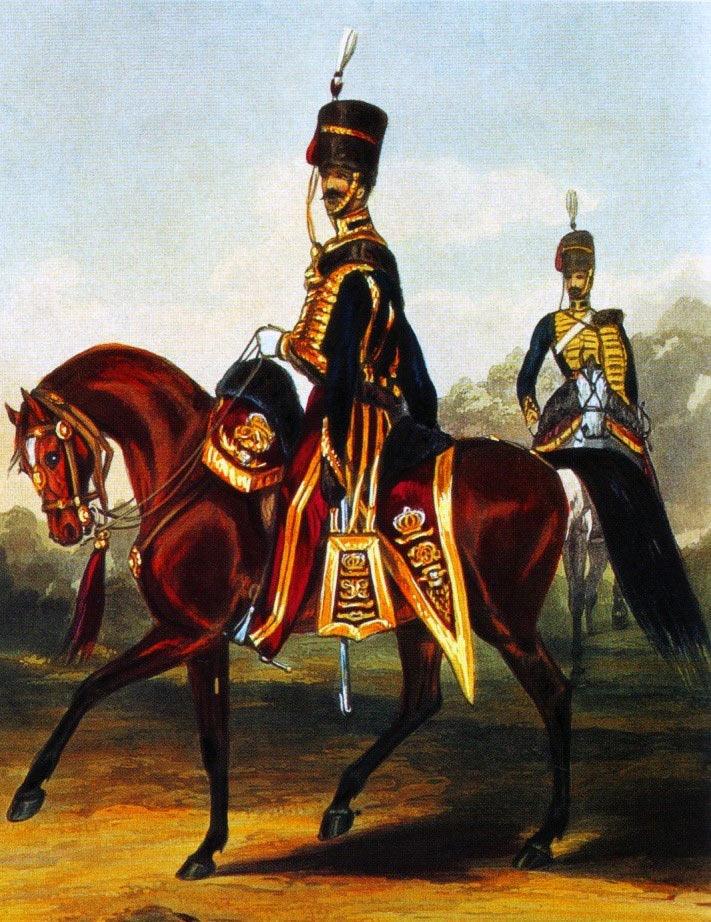
The police hurriedly had to escort a Royal personage about, a job usually done by Hussars. Their horses and they did a top job. Alfred loved fast driving and good horses, so a keen eye was appraising them.
Incredible to see a real Hussar – survivor of the famous charge at Balaclava – the Charge of the Light Brigade – was then a mounted policeman in W.A.
Hussar at battle of Balaclava, Crimea, where in 1854 the Charge of the Light Brigade took place.
With the help of one of the old Hussars, now a mounted policeman, the mounted police of Perth took the place of Hussars to escort the Royal person about.
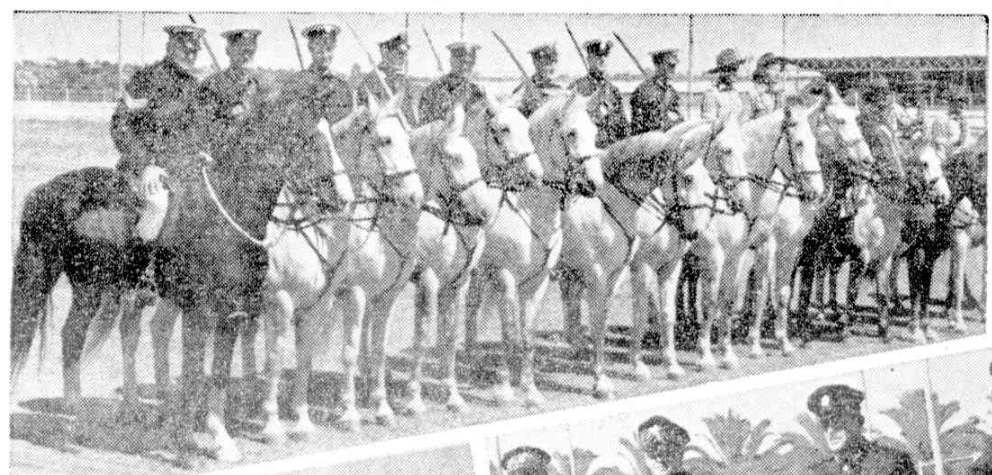
A bit more about the mounted police greys in Western Australia, they have a long history of using horses, their force was established in 1853. Thanks very much to Beverley Leonard who contacted us about her maternal grandfather Constable Street (riding on the left-hand side of the car in the image below & pictured in the inset), a very influential person in the development of the Police Greys in WA.
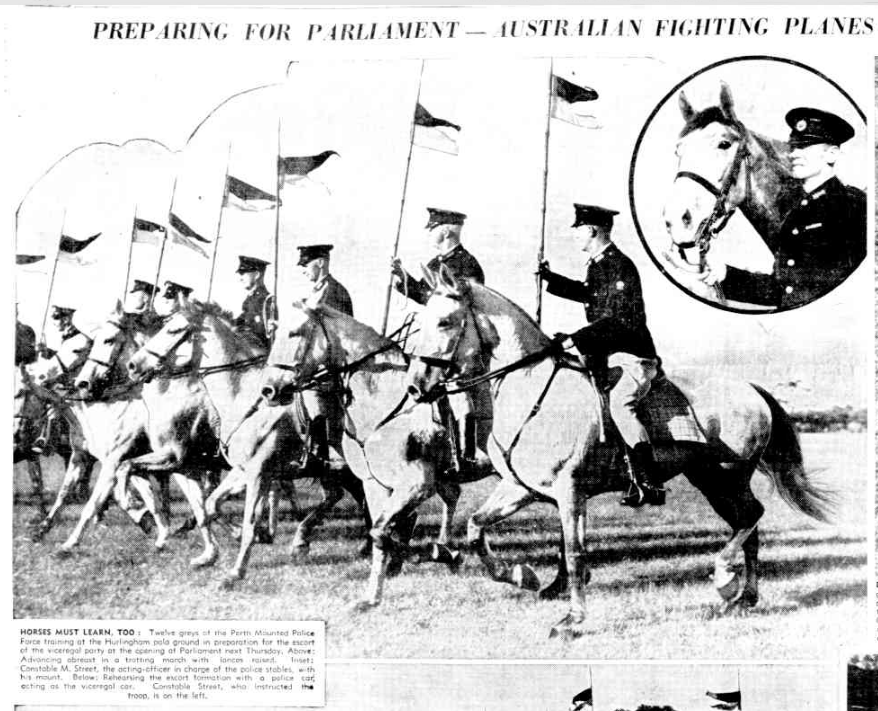
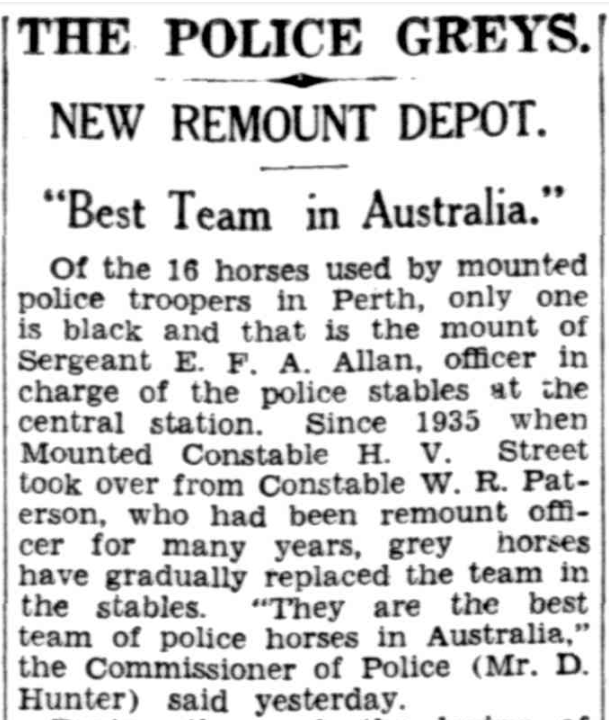
Image: West Australian, 6th September, 1941.
Constable H.V. Street was instrumental in the W.A. police turning to greys – inspired by the Windsor Greys. He was the police horse breaker and buyer from 1934 for many years! He chose super horses. Really knew his stuff. They had good safe action (unlike TB’s).
They began turning to greys in 1935. Fabulous looking for official engagements and highly visible when patrolling – this was reassuring during war time.
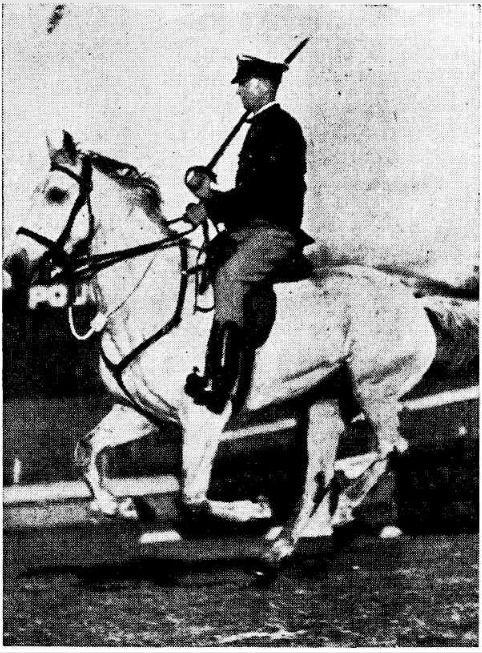
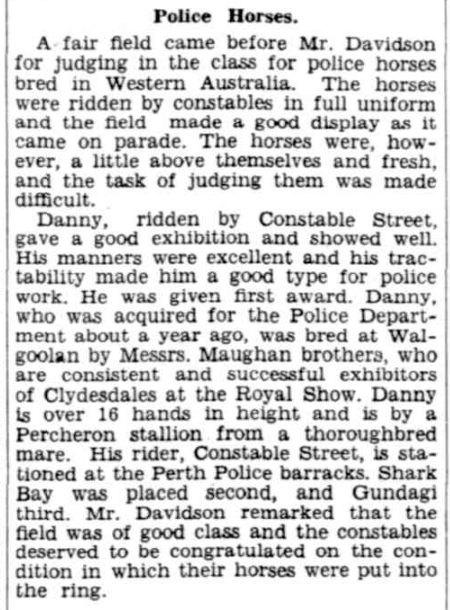
Images: Daily News, 6th October 1937.’Well known in Perth streets, Danny this grey horse won at the Royal Show yesterday with ease, the award of the J.F.G. Robinson trophy for a police horse bred in Western Australia. His rider is Constable Street.’; West Australian, 7th October 1936.
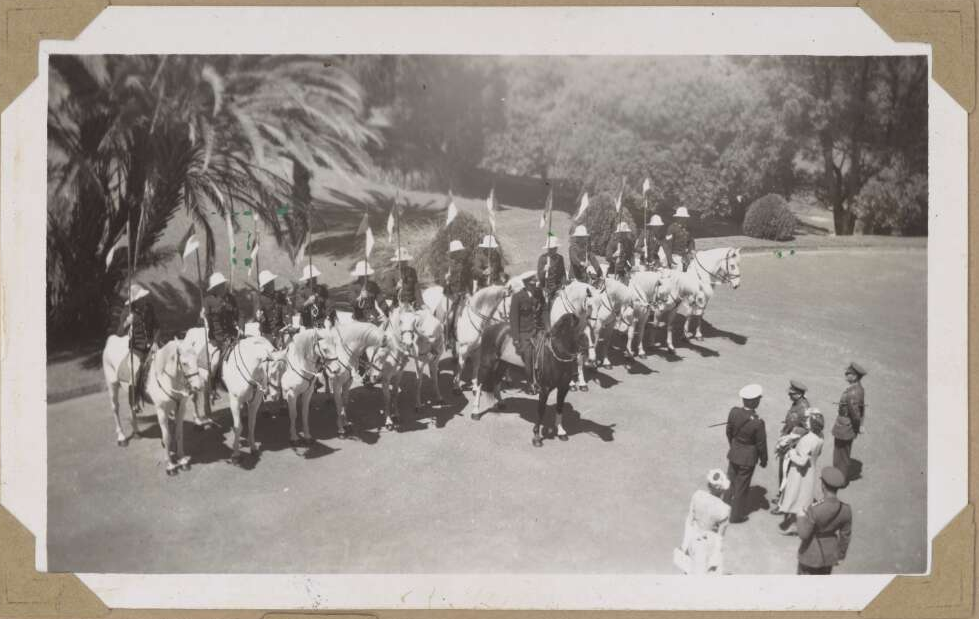
Photo by Alfred Amos,.National Library of Australia.
One of the mounted police jobs was to find lost people, often children, in country that vehicles could not access; many wonderful success stories.
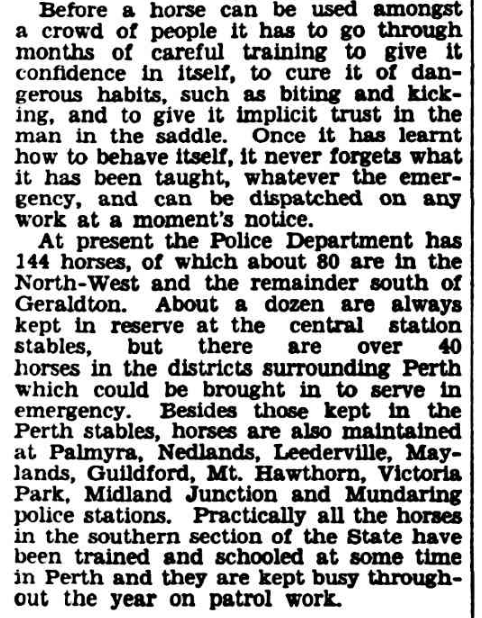
Image: West Australian, 14th September 1935.
Some great historical info re numbers of police horses and where obtained – station horses. No wonder they were so good.
W.A mounted police were skilled horsemen. As police were given a very small figure to buy mounts, they usually chose good but unbroken horses. They broke and trained their horses to a very high standard – usual police horse training such as going over narrow bridges, withstanding loud noises and flapping objects etc – plus tricks, and skilled mounted games such as tent pegging, tilting the ring, jumping, jumping in formation and much more.
They competed keenly with military riders at events and shows, often winning.
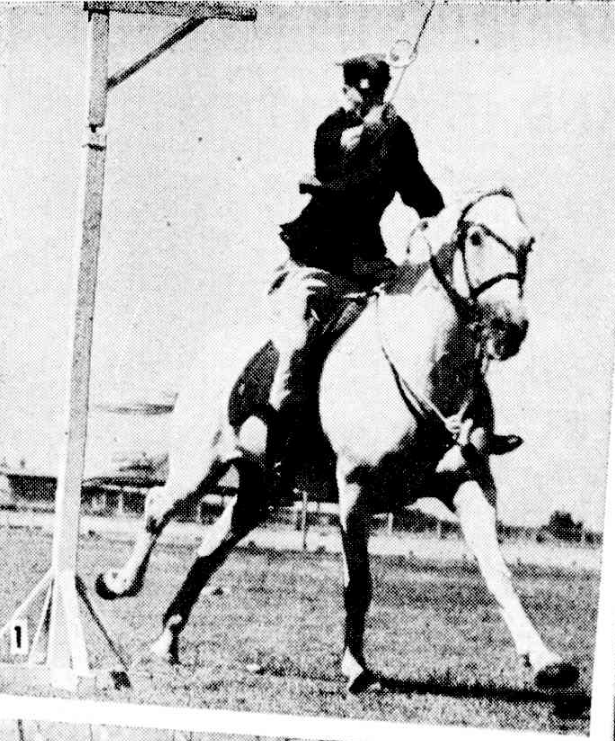
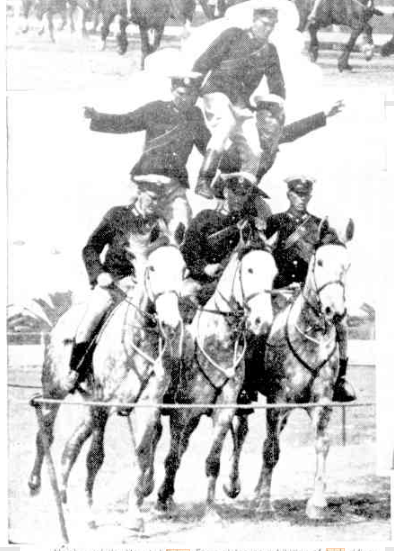
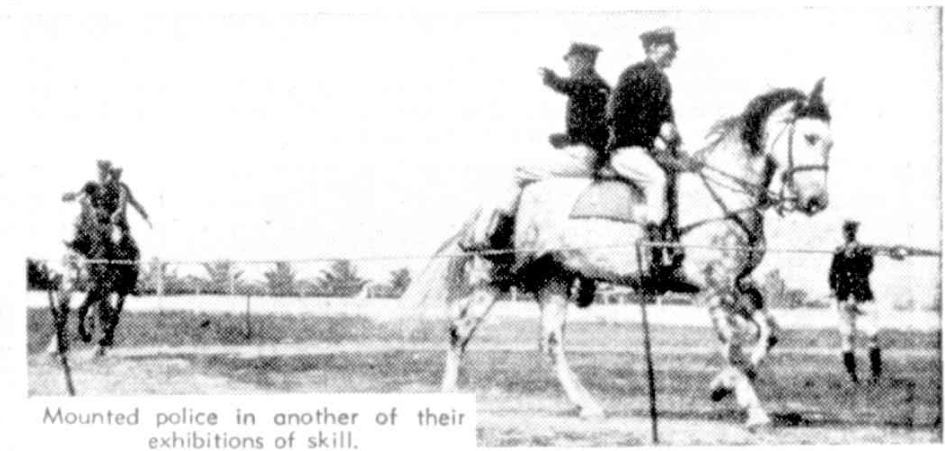
Images: Western Mail, 16th December 1943; Western Mail, 17th October 1940
As many men joined up in WW2, police were left short of personnel so many old retired policemen came out of retirement to return to duties to help out; including many good horsemen. The mounted police were excellent for morale during the war. Everyone loves to pat a horse. They were a visible protection in a time of uncertainty. They did many displays of trick and and other skilled riding, at many events throughout the war. They also escorted children from the 16 orphanages in Perth on outings, to the zoo and picture theatre, during the war.
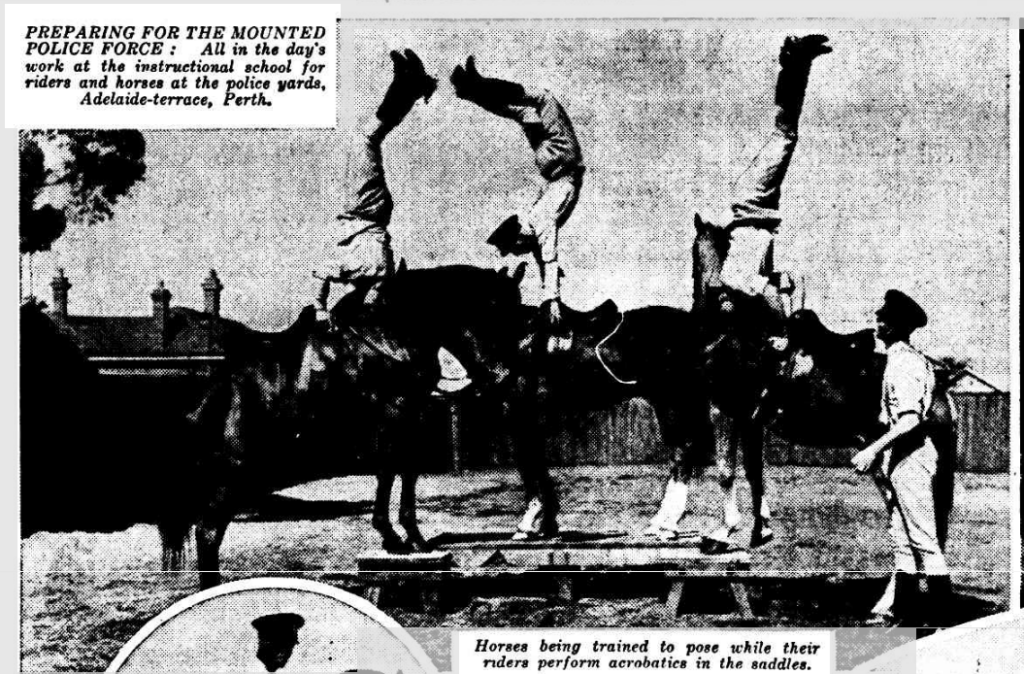
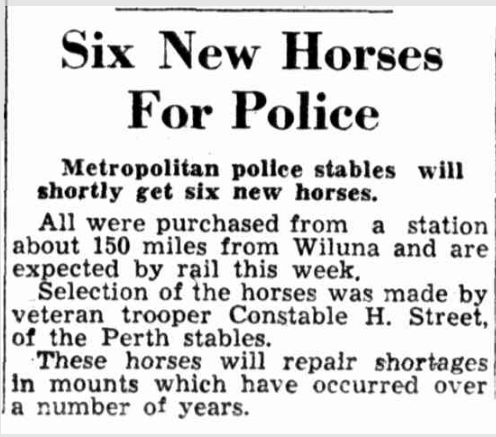
W.A. police usually chose station horses for their steadiness and hardiness, and there was a good supply of excellent horses, as W.A had had a tremendous overseas horse trade; the odd ex-racehorse was bought, and the occasional farm horse of known breeding such as Danny Boy.
The G. Robinson trophy at the Royal Perth Show, was for the best police horse bred in Western Australia. A great trophy indeed and incentive for good horse breeding.
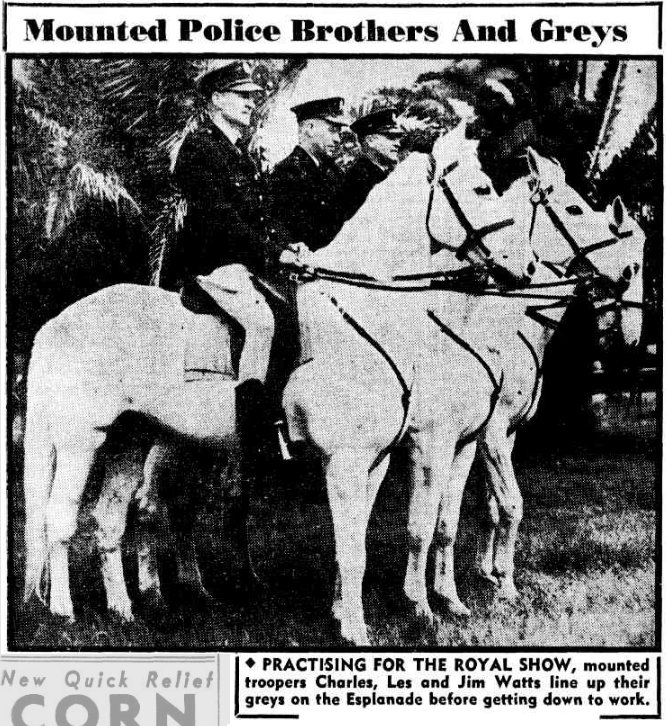
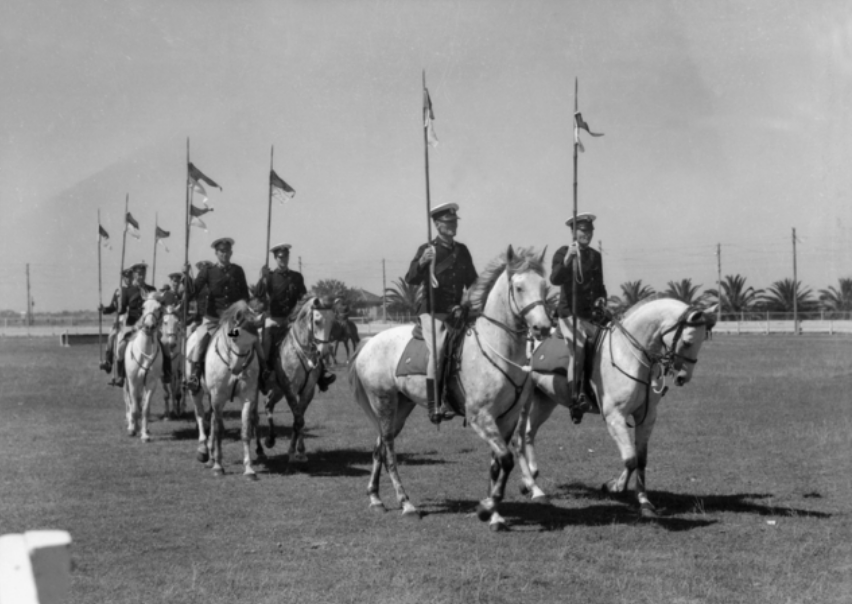
Images: Daily News, 3rd October 1947; Perth W.A. 7th November 1942. Police in a parade at Gloucester Park, part of a pageant to help raise 1,000,000,000 pounds for the austerity fund. AWM
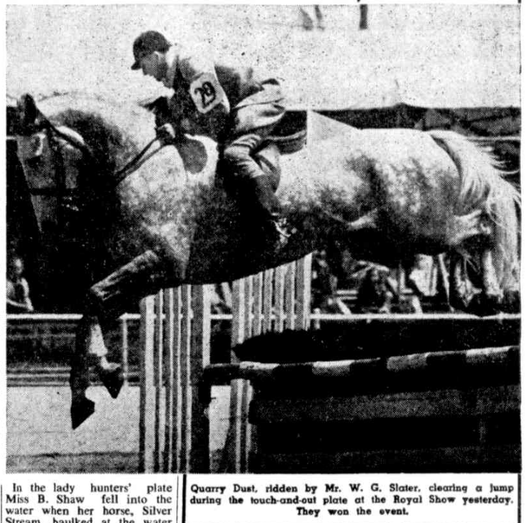
Image: West Australian, 7th October, 1954. ‘Quarry Dust, ridden by W.G. Slater, clearing a jump during the touch-and-out plate at the Perth Royal Show yesterday. He won the event.’
Thanks to Joyce Lindsay, we have learned about Quarry Dust. This horse competed at several shows a year for many years – at shows he was entered in jumping, hunter and hack classes, and had some good wins. He was also trained as a police horse, and called up for duty.
When Joyce’s Dad died in 1949, his farm – in Western Australia – was sold, and the W.A. police bought up the greys including Quarry Dust. What a compliment to his breeding!
Quarry Dust must have had very good training and been a very good horse all up, as he was called in for mounted police duty for the Royal visit 1953-54 and, and again on the occasion of a later Royal visit to W.A.
This is the only photo I could find identifying Quarry Dust however he would be in the many photos taken of the Royal visit, where the mounted police and their horses did a sterling job in Perth. The horses were outstanding – as well as all the fanfare and massive crowds, the city’s churches all tolled their bells! The W.A. mounted police and their horses did not put a foot out of place.
Well done Quarry Dust and thank you Joyce and your dear Dad.
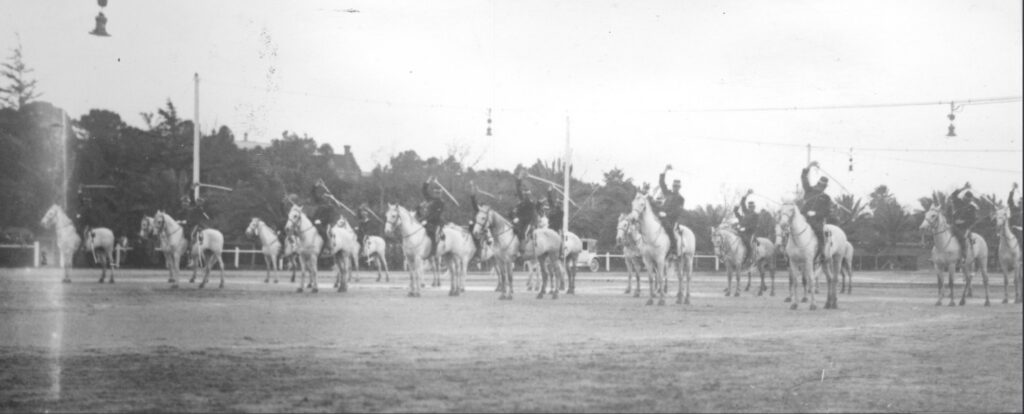
Police Greys were in other states of course, South Australia in particular. The S.A. mounted police in the 1800’s had an incredibly huge territory to cover. They needed tough, wise horses. As the budget for horses wasn’t big, it was found best to buy good horses that were unbroken – the police had their own breaker and the men trained their horses for work, which makes a good strong bond. The tradition of training their own horses continued.
The tradition of ‘Police Greys’ pretty much started in the WW1 era as other colours were snapped up for army use. They were distinctive and popular with all, easily seen such as at crowd events which helps safety. It became official policy in 1951 to have only greys.
The mounted police put on fabulous displays of skilled riding at shows such as Adelaide Royal, fundraisers for many charities, and the Police Sports Carnival. They went across to Perth Royal by invitation in 1948 (and probably other years) and competed against the Perth Mounted, Menz was one of the five chosen to represent South Australia that year.
Some of the mounted police riding skills were also done by the Light Horse, such as tent-pegging – also done with both sword and lance by the mounted police, horseback wresting, tilting the ring, section jumping and much more.
Thanks to Richard Mails for the photograph below and information about Alfred Menz.
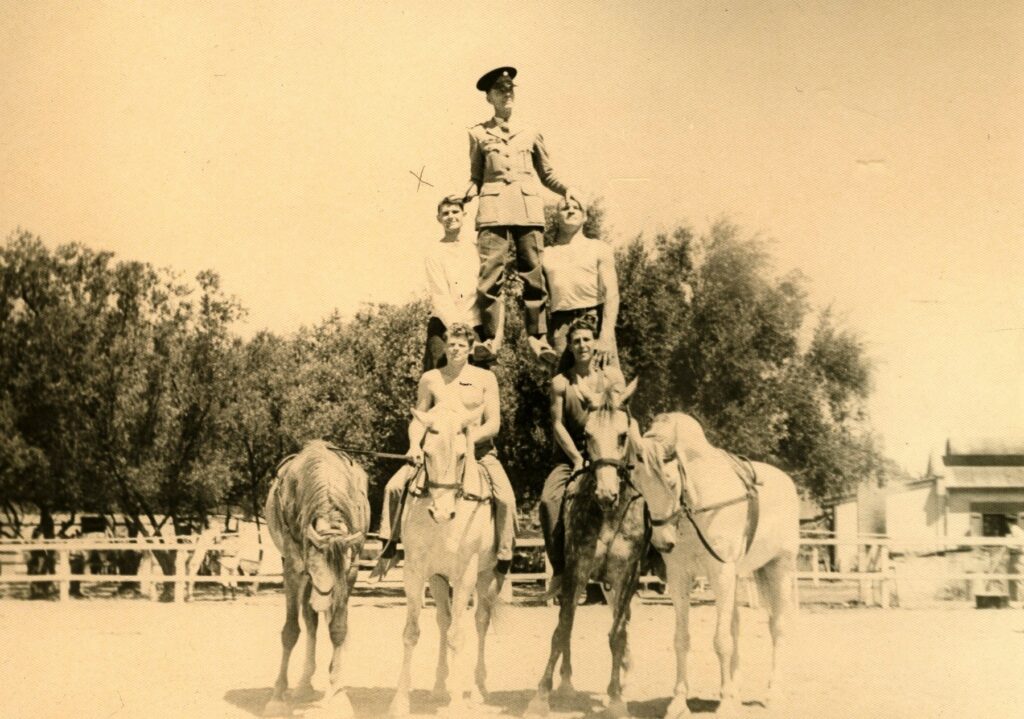
“Alfred Menz was instrumental in forming a highly skilled SA Police vaulting team. He joined the Army during WWII and became a military police officer. He was captured by the Japanese at the fall of Singapore and held as a POW for more than 3 years.
At the end of the war, upon being returned to Australia, he returned to policing (and vaulting) and remarkably returned to his muscular physique within a short period of time. Possibly the coolest part is that he saddled up and rode a police grey in the 1984 Adelaide ANZAC Day March with other police veterans. A legend of a man.”
In his time in the Army Alfred became Captain then Lieutenant in the Army Provost Corps (military police). Despite the hardships endured as a POW, after the war he recovered and returned to the mounted police. Born in Kalgoorlie in 1908 but spending most of his life in South Australia, Alfred passed away in 1990. A life well lived.
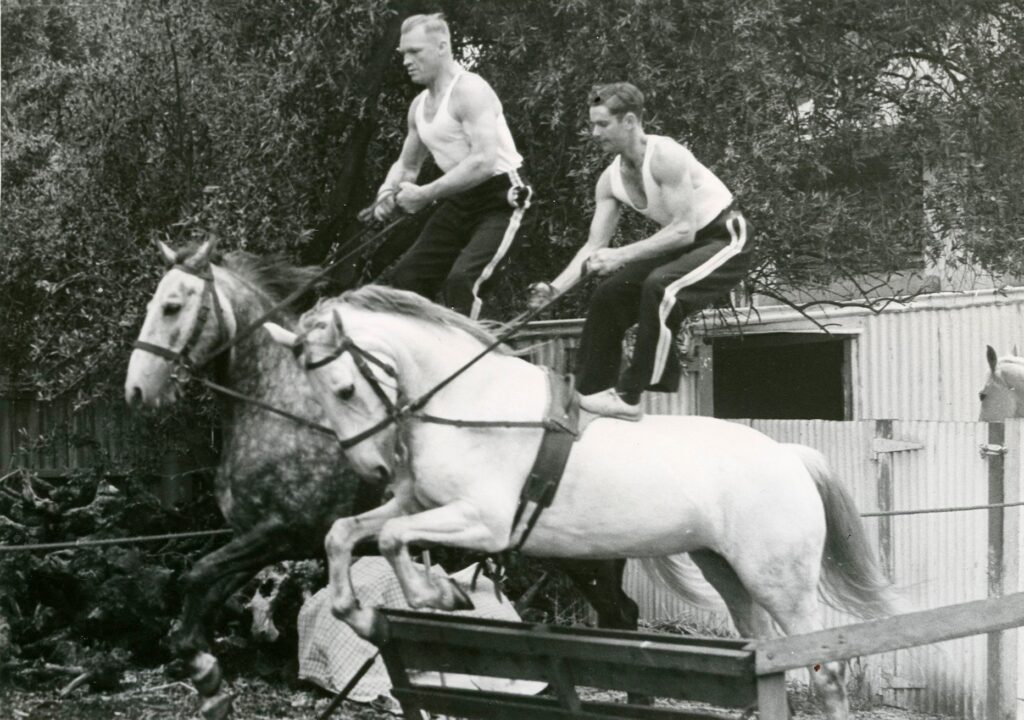
Sergeant Alf Menz trained the horses and men in vaulting, jumping and other skilled riding techniques. In his era many of the horses came from Granite Downs, Lambina and Eringa – bred as Walers. No doubt other station horses were bought too.
Many of the South Australian police horses in this era were bought from Jim Robb. They were bred on Lambina and Granite Downs stations. Jim bred for India as well as the local market. A grey polo pony of Robbs bought in India by Colonel Atkins of the 16th Lancers, ended up in America after Atkins got an offer he couldn’t refuse.
Jim Robb had 41 trips to India with his horses. They sold to the 9th Lancers and 16th Lancers and other regiments, as well as artillery, and for paper-chasers (his Grecian Type won several paper-chasing trophies.)
They won most major events there such as the Kadir Cup (pigsticking) and events at the prestigious Tolly (Tollygunge Club). Some of the best polo ponies in the world also came from these stations when Robb had them, such as Lady Jane which belonged to Prince Hanut Singh of Jodphur, who played with the Duke of Edinbugh (Philip).
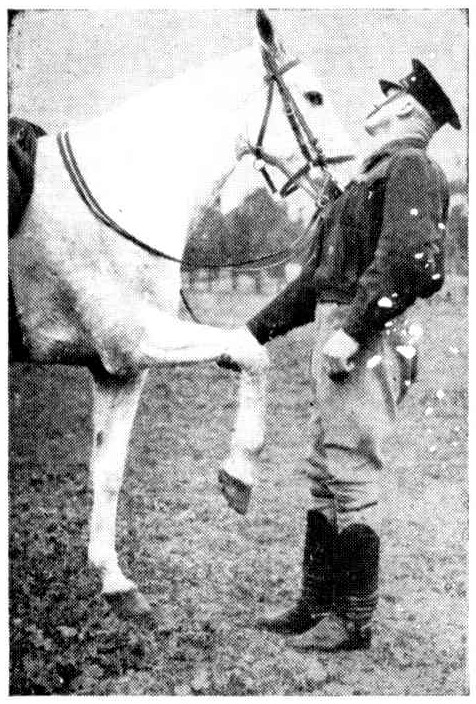
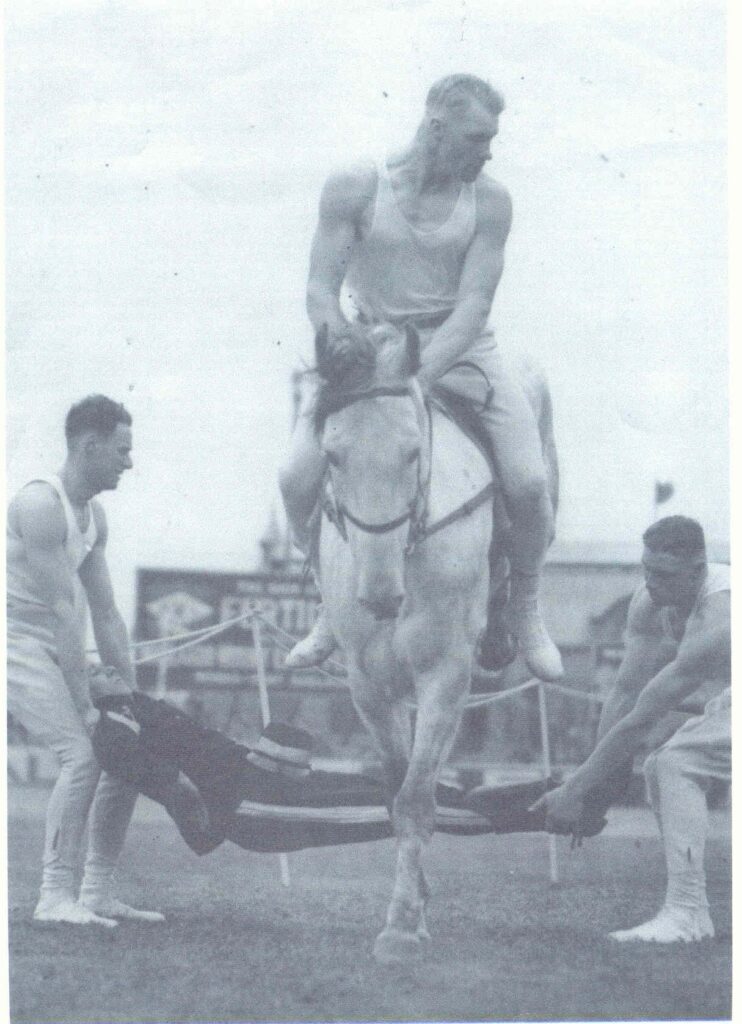
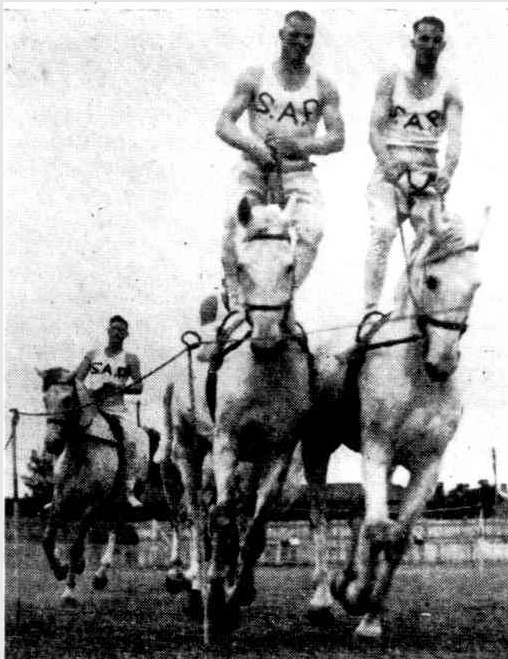
Images: Sergeant Alf Menz shakes hands with his mare Frances after tent-pegging training. Frances was the mount of the “Red Shadow” in a performance of “The Desert Song” at the Theatre Royal. The Mail, 9th July 1949; Alf Menz – Wayville Showgrounds 1930. The News, Adelaide 1930; Police display at Hindmarsh. South Australian mounted police gave a thrilling display of horsemanship at the Hindmarch horses-in-action show at the Hindmarch Show this afternoon. Two of the riders standing in their saddle while their mounts gallop. The Mail, 29th October 1938.
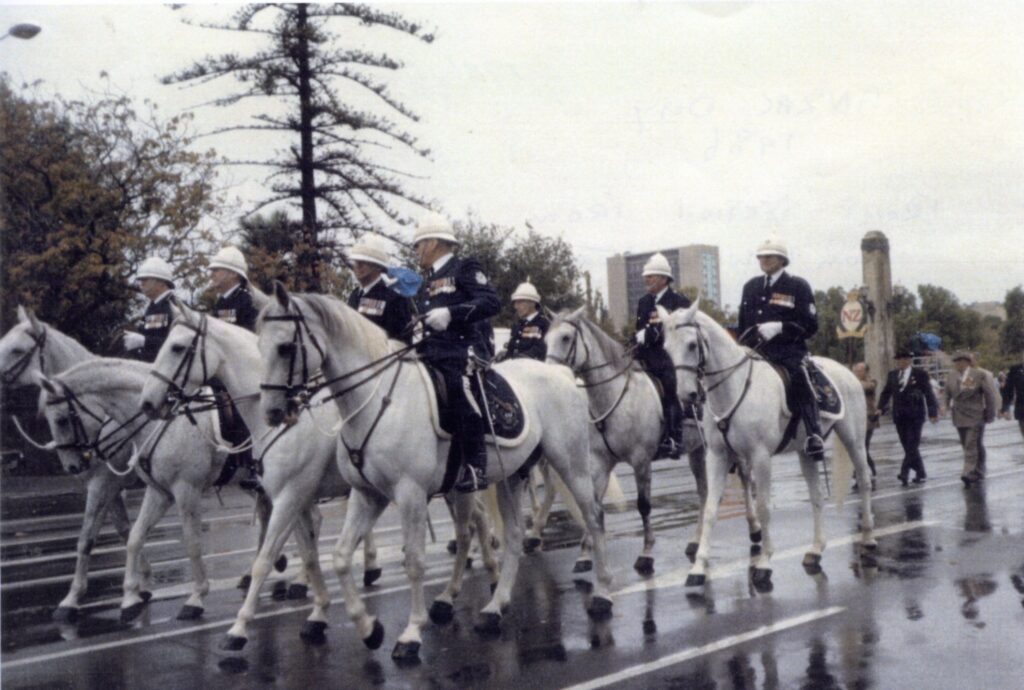
Front Left to Right 1. Tom Howie 2. Jack Cawley 3. Noel Smith 4. Alf Menz
Rear Left to Right: 1. John Walker 2. Tom Flynn 3. Jesse Jones 4. Jack Menz. Richard Mails photo.
