
Sarah Stork


Waler Data Base @ Facebook. Image: ‘Sarah Stork with horse bus… 1900-1920.’ Sutherland Shire Libraries, NSW
Sarah Stork was a well-known coach driver for her working life, even managing the transition from horse to motor buses as these became practical. She started out on very rough bush tracks, in mountainous country. She came from a family of battlers, her parents however managed to educate her until she was sixteen.
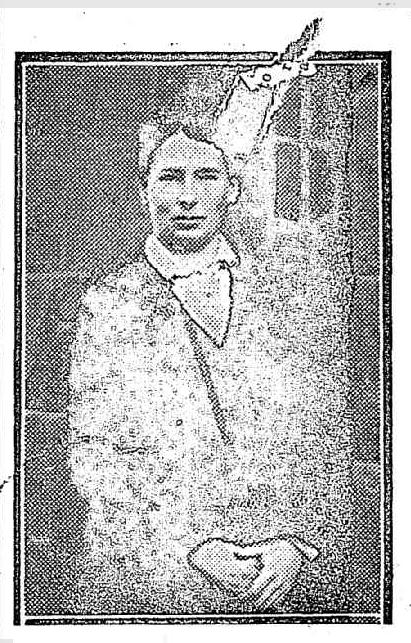
Her parents had migrated from England to Sydney where Sarah, their only child, was born. At age 4 months, her father ill, they moved to Waterfall, NSW, the climate supposedly good for those with advanced tuberculosis – 80% of those who caught TB in those times died of it. However he went there primarily for work on the railway.
Every day from their Cawley Village cottage near Waterfall, little Sarah walked 6 miles to school. Times were very tough, and by the time she was in her teens, there was no more money for schooling. Her father passed away in 1908.
Image: Sunday Times, 5th July, 1914
In 1909 the government began building a large sanatorium at Waterfall for children with advanced tuberculosis. The men working on The Waterfall Consumptive Hospital had to trudge miles from the railway station to work, often in cold rain – one suggested to Sarah she start a bus service. She took the idea seriously, and her mother backed her up. She could not afford a coach, but with her mother helping, managed to get together enough for a good little horse and sulky, partially from a loan, about 1909. She got an omnibus license and went into business – it flourished! She was 19.
She got plenty of passengers and soon got a contract to cart all the heavy timber to the Sanatorium while it was being built.
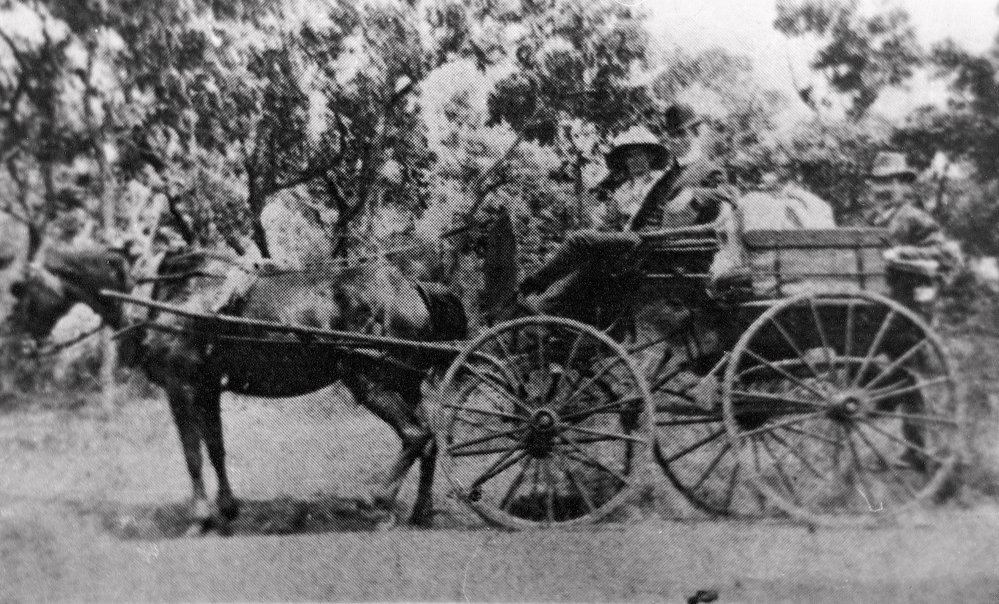
Known as Sarah to one and all, in no time Sarah progressed from a sulky and horse – always groomed to perfection – to a pair of horses. Her bus service was hailed by the workmen as a life saver!
Before long she could indeed buy a coach. By 1914 she owned nine good horses and three coaches. She got more government carting contracts including for the railways, as well as lots of local carting work. She carted anything from bricks to furniture, and if she got bogged, would dig her vehicle out. Later her son helped her. She kept up the coach run. She drove a pair for a time, then soon as she could, bought more coach horses – she drove a four in hand daily up the rough steep track to the Sanatorium. Even better, she was known to go out in all weathers, or night-time, to rush sick and dying people on request to hospital, she never let them down. One train came in at midnight – she always met it. She always drove herself – famous as an excellent coach driver.
Inspired by Sarah’s success at least three other coach services started up in opposition. One by one however they gave up the Waterfall run as passengers stayed loyal to Sarah’s reliable service.
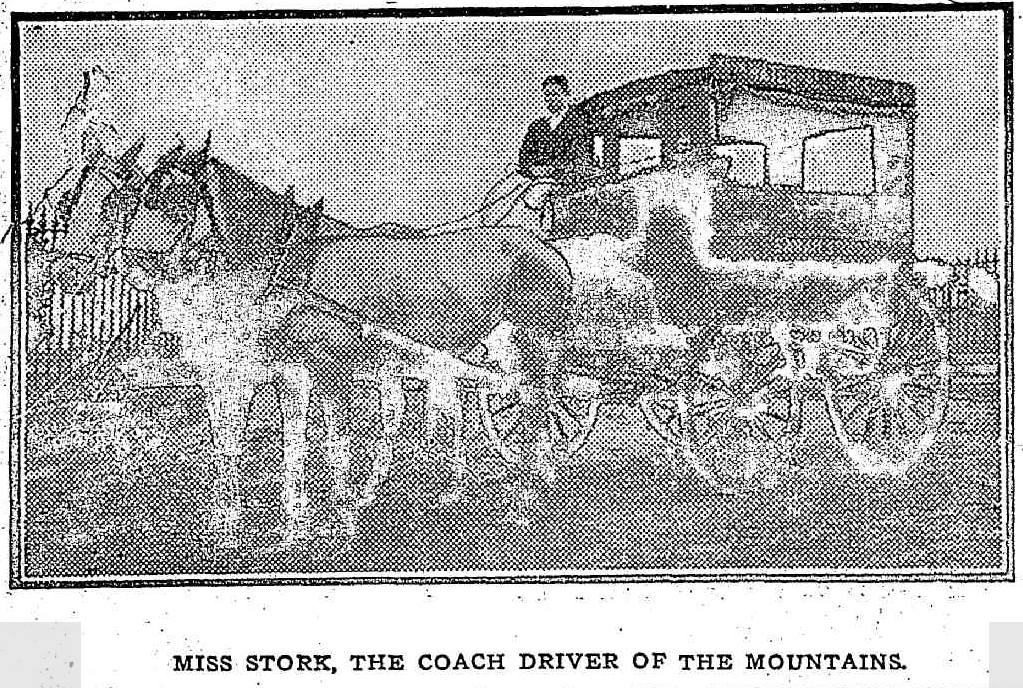
It wasn’t just sanatorium workers and locals who used the service, but many tourists. The roads were very ordinary to say the least when she started, needing skill to guide her horses through. Her coach met every passenger train that came to the station – a welcome sight. In winter and a few other times she spent each day waiting for trains, but no bus passengers. It was chiefly the weekend that brought paying fares, but Sarah nonetheless met every train all week, in case. She was a byword for reliability and worked 7 days a week.
She spent hours daily attending to her horses. They were known to respond to simple verbal commands. She could gallop five in hand with ease, and everywhere she went her loyal carriage dog ran behind the coach – also an excellent guard dog – she was never bothered by criminals.
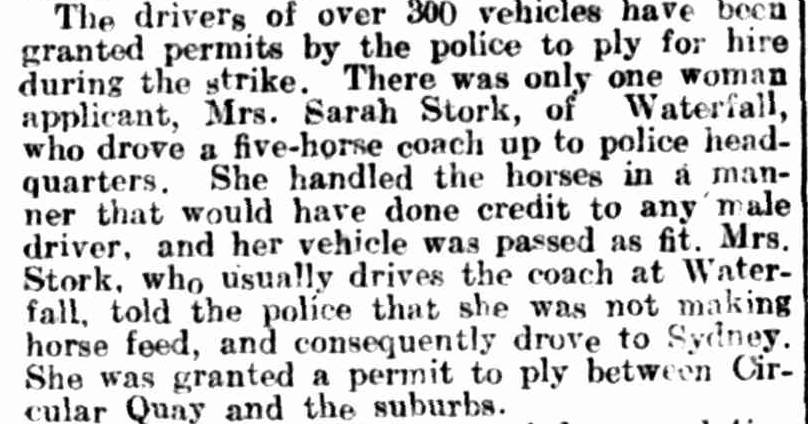
She was earning a good living and employed other drivers. Sarah was an accomplished driver. She went into Sydney in the 1917 tram strike, to run workers from the Quay to the city and back, with her four-in-hand, dexterously weaving through traffic.
Image: Maitland Weekly Mercury, 25th August, 1917
In 1914 Sarah married James Winfall, a cook. James went to WW1 but returned safely in 1919. She had her first child then, but took little time off, continuing the bus business. She now had her baby, her mother and herself to get through life. She and James had two children together, however in 1925 Sarah applied for divorce on grounds of desertion. In 1930 she married Walter Mason. Sadly, he died in 1939. All her life she was simply called Sarah by everyone.
Once motors came in, she branched into motor buses. In 1918 she got her first motor lorry, Sarah carried 60,000 bricks to the hospital, when no-one else was available! She added a roof and seating to convert the lorry to a bus when needed! by 1923 she owned two coaches and horses, and two International buses with removable bodies, so she could use them as trucks when needed. She drove an International herself.
She won several cartage contracts and soon bought another lorry for timber cartage from the National Pass to the railways, having two lorries in work at any time as well as several buses.
In 1922 she was carting gravel to the men in Bulli Shire working on the Prince’s Highway, the men hailing her as a woman in a thousand as she was always on time.
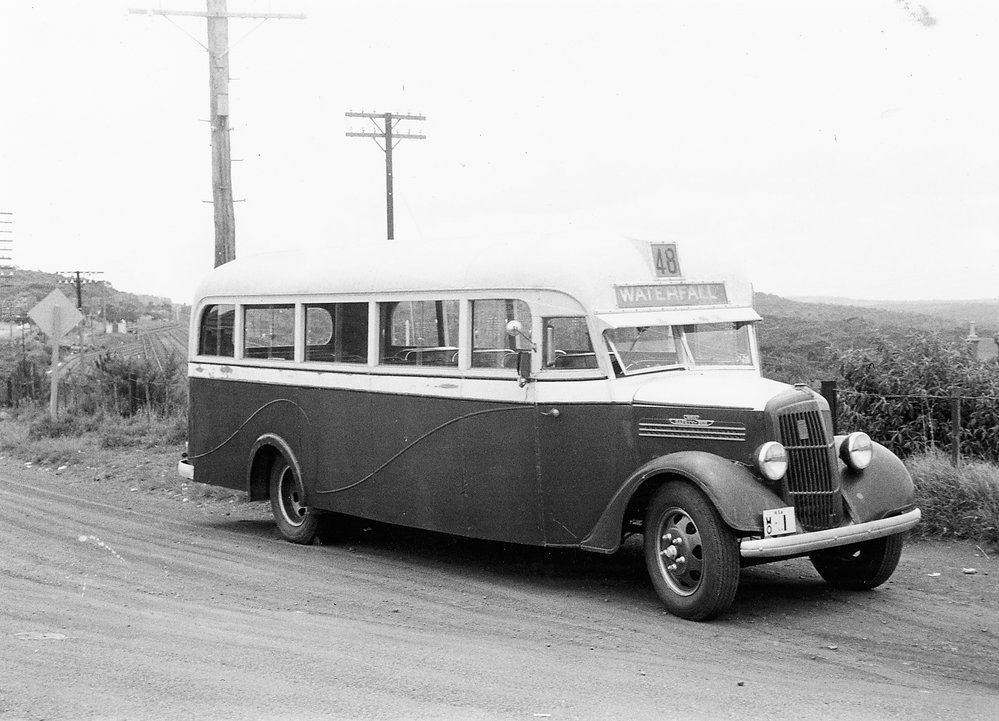
Sarah was the first woman in NSW to be issued an Omnibus licence. She held it almost 50 years. Her daughter Dorothy and son in law Doug McCubbin helped run the bus business in her later years. Sarah passed away in 1970, aged 81 or 82 (accounts vary).
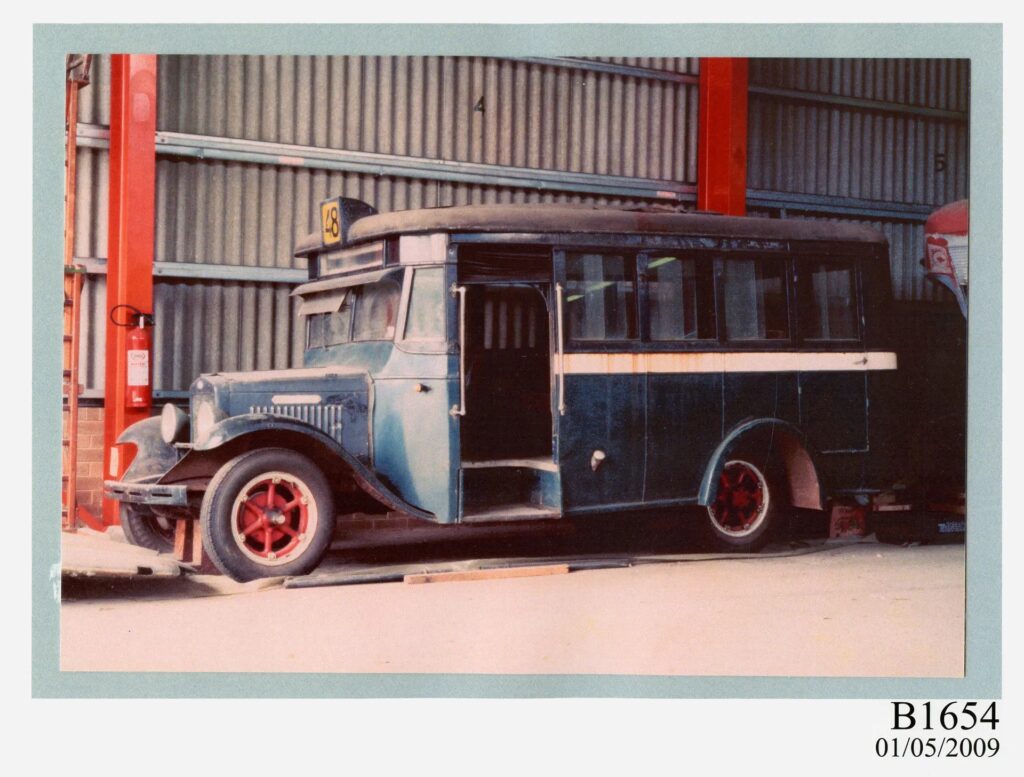
‘This 1934 International bus comprises an American truck chassis built by the International Harvester Co. and a local Sydney-built body, by Syd Wood of Bankstown. The bus operated in the southern Sydney suburb of Waterfall from 1934 until 1967 and is believed to have been the oldest bus still in operation in New South Wales at the time. In an era before the popular ownership of cars, the bus provided transport for visitors and patients to the Waterfall Sanatorium, picnickers to Woronora Dam and swimmers to Garie Beach in the Royal National Park.
It was owned and operated by Sarah Stork, who as an enterprising teenager established her own transport service with a horse and sulky for workers building the Waterfall Sanatorium in about 1909. Sarah was an expert horsewoman and single handedly built up, firstly a horse-drawn coach service for the route between Waterfall Station and the Sanatorium, and then from the 1920s a motor bus, taxi and haulage business.
Even as late as 1965 this little International bus, still operated by Stork Bus Services, could be seen at Waterfall Station standing between runs to the Sanatorium. Sarah referred to the bus as “Biddy” but to locals it was affectionately known as “Old Biddy”.
‘Sarah Stork pioneered and operated her own bus service for almost half a century. She was also said to have been the first woman in New South Wales to be issued with an omnibus driver’s licence which she held until the age of 74 in 1963.’ Powerhouse
