
Amazing Feats

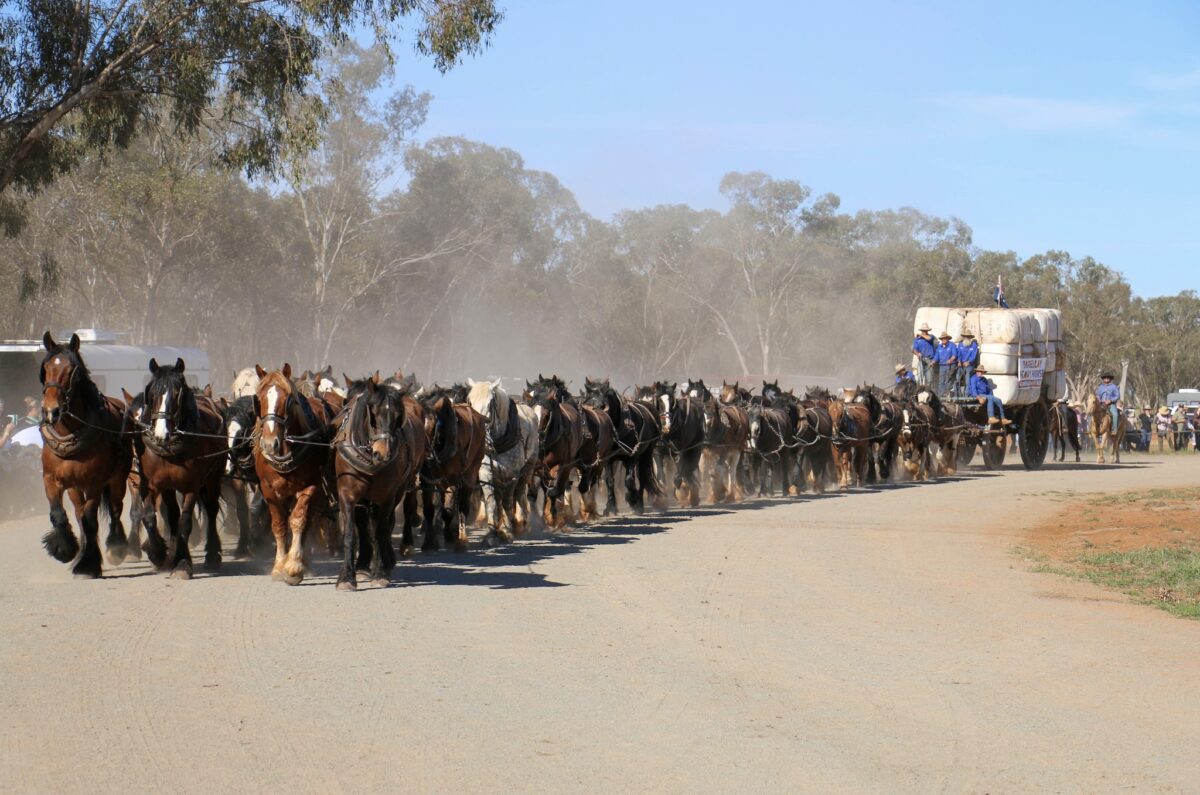
Waler Data Base @ Facebook. Image: World Record 62 Horses pulling a wool wagon, October 2025, Australia, Barellan Working Clydesdales “Good Old Days Weekend” Facebook page
Right up until the present-day Australia has achieved some of the most amazing feats to be found anywhere in the world. A few stories are gathered in this post to inspire you to think big, those surely were the days.
Have a look at the Facebook page for the Barellan Working Clydesdales “Good Old Days Weekend” to be astonished anew. And a visit to the Facebook page of Boyd Exell, current (& 7 times!) world champion four in hand harness driver originally from Bega NSW is a real treat to see Australia on the world stage.
Air-freighted Bulls
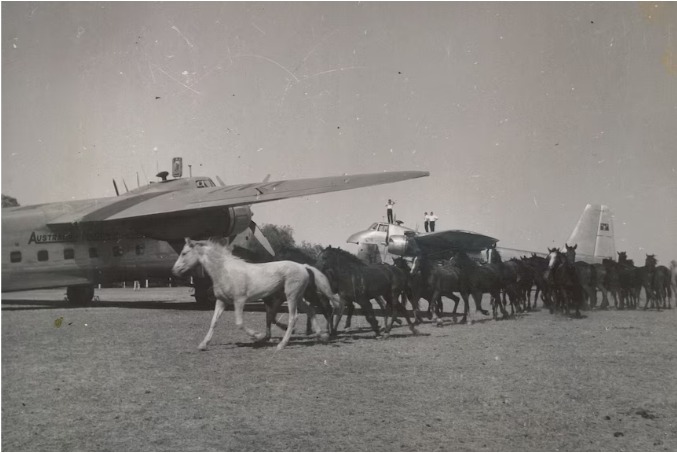
Two Bristol planes delivered bulls to be auctioned at the annual race gathering on Brunette Downs, a two-day event.
It was the first bull sale held in the NT. 31 Shorthorn bulls from Victoria and NSW were auctioned, realising 50 to 400 pounds, on average 202 guineas per bull; the government subsidised by paying half the air freight charges, which were 200 pounds per animal, and 3,000 pounds to upgrade the Brunette Downs airstrip.
At the time station owners had just come out of drought, and as most places were unfenced, buying an expensive bull was a punt. Jim White who owned Brunette Downs donated the proceeds of one of his bulls, Brunette Tomahawk, to the Flying Doctors – the bull was from NSW where he lived, the station being managed by Eric Barnes; this bull got second highest price of 300 pounds.
Top priced bull was Woomagarama Quick March from Fairburn & Co., Albury which sold to the Gulf Cattle Co.. W.B. Cameron who owned several stations in the NT and Gulf, bought several bulls for his Gulf Cattle Co., he said all sold too cheaply.
At the time it was said to be the biggest airlift of cattle in the world.
There had been several stops to collect bulls and they all behaved perfectly. At Brunette they walked off the plane onto a tabletop truck, driven the few miles to the homestead (which is a few miles from the racetrack area), then led down a wide ramp and onward to stalls. Altogether there were 4 plane loads. It all went very smoothly. Vet J. N. Barnes from Alice Springs was on hand, and inoculated bulls against tick, as some were from tick areas, and did regular temp. checks.
At the sale, Daphne Calder, who had been Daphne Campbell – the actress in the Overlanders – was one of the people who led the bulls about at their auction.
Eva Downs, Woodgreen, Hamilton Downs, Anthony’s Lagoon, Rocklands, McLaren station, Ammaroo, Wave Hill and Narweitooma stations were among the buyers (link with sellers and buyers). One bull that Woodgreen bought died 6 months later in a drought.
Some people drove to the Brunette Downs races, some flew in their own planes. It was run by the ABC race club – which stood for Avon Downs, Brunette Downs and Creswell. The races went for two days and well over 1,000 people attended; a big annual event and social gathering, like all bush races. There was also a rodeo and campdraft. Evening dances. Most of the race horses had stayer TB in their lines, most being station bred. The ABC Cup in 1953 was won by the bay Browner, of Anthony’s Lagoon, owned by Mr. and Mrs. Cant – he’d also won it in 1952.
Side-saddle jumping
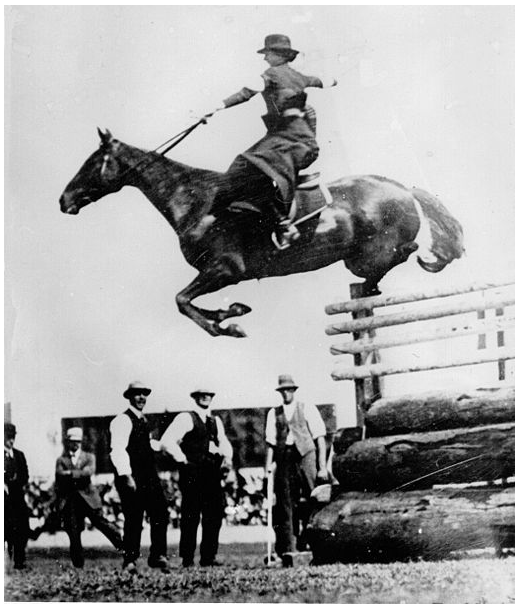
Image: Esther Stace completing her record-breaking side-saddle jump on Emu Plains at 6 feet 6 inches at the Sydney Show in 1915. Source: The Morning Feed
World record made. Mrs. Esther Stace from Yarrowitch NSW, riding sidesaddle and clearing a record 6’6″ at the Sydney Royal Show, 1915. Her record stood until 2013.
The prize money was 5 guineas and a blue ribbon.
Miss Myra Smith riding Bandolier also cleared the 6’6″ jump, but Esther came first by clearing it at first attempt. Miss Smith cleared it at her second attempt.
Esther rode T.E. (Dolph) Judd’s 16hh brown gelding Emu Plains; Judd lived at Tichborne, NSW (according to one report although it appears he lived at Blayney NSW, moving to Bathurst 6 years before his death) and kept a string of top jumpers. Emu Plains won several events at that show, most ridden by Esther such as the Ladies Hunt; for one event win he was ridden by R. Curry. Emu Plains, at the time a 12 year old, was bred by Mr. Prentice of Emu Plains.
A fearless rider, Esther also rode hunting in rough country. Her first competition ride was at Walcha Show in 1891. About that time she rode her own horse, The Joker. She also rode well known jumper Desmond, for H. Morton. Slightly built, she was known to handle difficult horses with quiet confidence.
She went on to gain many ribbons at shows, including Sydney in 1910, 1912 and 1914. Her favorite riding outfit was a plush scarlet one. She died in July 1918, aged 46, after an illness. At her funeral, her coffin was draped with many of the ribbons she’d won. She left a husband and three children – a daughter and two sons – the sons, at the time of her death, were away fighting in WW1.
In that year, 1918, Emu Plains, then 15 years old, cleared 7 feet 1 inch at Sydney, another record – in the men’s jumping.
Child Drover
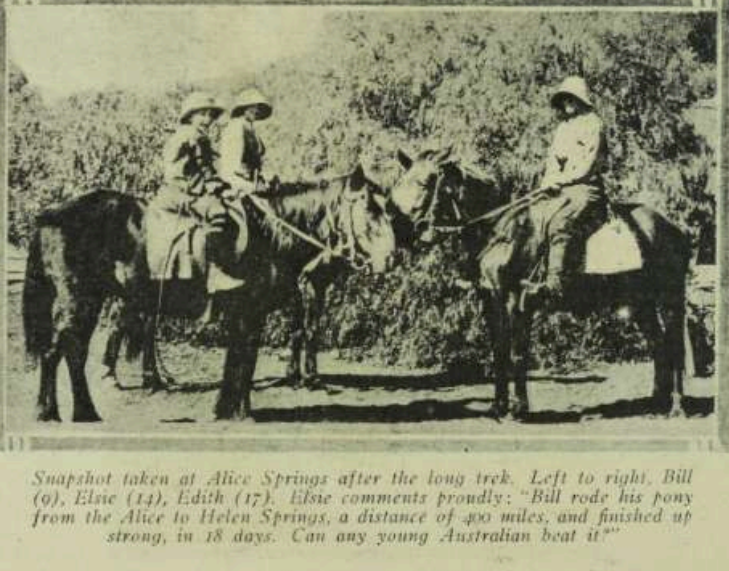
In 1924 14-year-old Elsie Bohning went droving with her Mum, Dad, little brother Bill who only nine, older sister and two Aboriginal stockmen. The route was mostly along the Overland Telegraph line, very rough and unmarked in most places.
They took their own Shorthorn bullocks and a flock of goats from Helen Springs – Northern Territory – where they lived, picking up more bullocks along the way at Tennant Creek, Bonney Creek and Wycliffe Well. The first three days, as usual, were tense until their cattle settled, thus becoming coachers for those collected along the way. There was always a night rider or two while most of them caught up with sleep at night after dinner around the campfire.
The hard part was getting cattle through poison patches. If they ate these poisonous plants they quickly died, but they were uncertain which plants caused it.
Some Eremophila species cause lethal cyanide poisoning in cattle. Unfortunately they struck such a patch and lost 70 out of 400 cattle, and had trouble holding the rest as they panicked about their comrades dying.
Rather than being unsure about which plant was killing the cattle, their Dad observed one bullock munching away at a “fuschia or sage bush” – rather than stop it – the beast soon died so they pushed the cattle on quickly when these were seen along the way.
Twenty seven horses were in their plant, some carried packs, and they took a dray. The three children did the entire trip, the bullocks taken to Woodforde Well over 400 miles away, where they were sold. They wanted the cattle to arrive fat so took care along the way.
Elsie was very proud when along the way, Mr Hayes praised their cattle. Elsie wrote a letter about her trip to the magazine (story on page 18, last little bit on page 55).
Adrift at sea
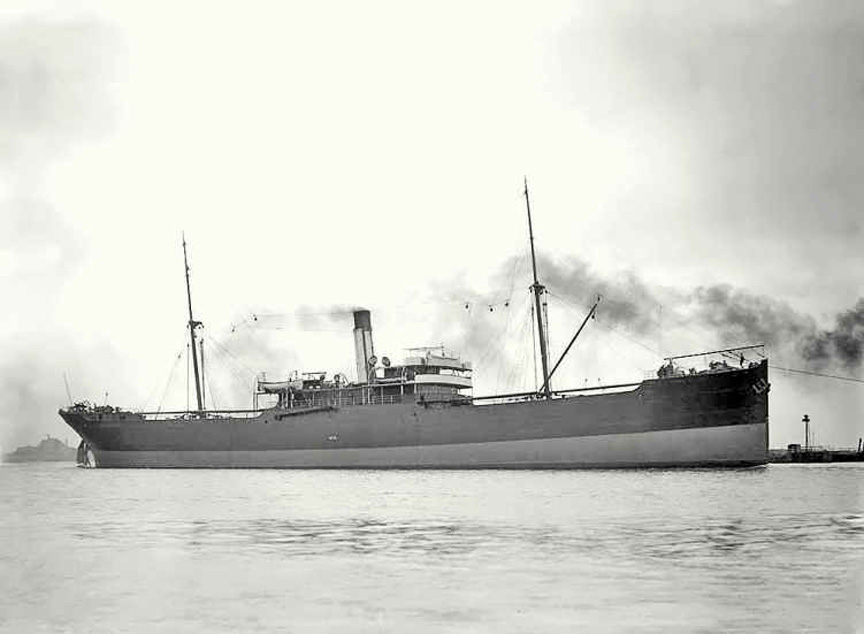
In 1901 the steamer Boveric with 965 horses shipped at Sydney, Newcastle and Melbourne, set off for Durban, South Africa. The horses were for the Boer War, a private consignment of quality horses that would sell like hot cakes, horses being in huge demand. It was the largest number of horses to be shipped in one load at that time. She took 65 stockmen. The horses were sent by experienced trader Donald McInnes. His brother Allan, an excellent horseman, travelled with them on the ship.
Allan had been sending horses from the eastern states to Western Australia for seven years. He’d spent the past three years also sending them to his brother Donald in the Rand, South Africa, but Don had returned to Australia when the war broke out, and arranged this load himself (another brother was a soldier in this war). Don had sent other loads over for the war.
Captain Lewis A. Leslie had been in command on the Boveric for a few trips. She couldn’t have had a better master. The usual stow-aways were found – thirteen on this trip. As Boveric was considered “a lucky ship” this number didn’t worry anyone. Nonetheless, seamen are superstitious and the men kept busy trying to find another stowaway. Thirteen, however, it was.
Ten days out of Durban the ship shuddered dreadfully. Disaster! Boveric had lost her propellor. That left her helpless. When it happened she was 30.4 degrees south and 96.23 degrees east – a thousand miles from anywhere. She drifted. They made makeshift sails and attached them to the derricks – she was north of the usual trade route – outward ships went in a higher latitude to inward ships, and she’d gone higher still. No other ships were on her route.
As she ran under her jury rig when a breeze finally came she’d make a couple of hundred miles, then it would go dead calm again, currents and swell would carry her back north. They kept busy making more sails. The Captain was worried they’d get into the trades and be carried still further from any landfall. Several times they re-crossed their own track, desperately trying to go southwest but being taken north.
She remained stable so the horses had a smooth time of it, even in big swells. Every now and then the Captain dropped buoys overboard, attached to which were bottles containing pieces of paper with her position at the time, and the need for help.
After eight days of drifting the Captain met with his officers, then called for volunteers to take the life-boat for help. She would be set up with sail and supplies. All men volunteered, making the Captain very proud of his crew and the horsemen. He chose the Chief Officer Henry Hayman, the Second Officer W. McCarthy and two AB’s, H. Dry and T. Timmins.
The little crew of four set off with Captain Leslie’s blessing, facing one of the world’s longest stretches of ocean, all the way back to Australia. After 27 days and 1,500 miles of sailing – perhaps the longest trip in a small boat for rescue ever – the brave little crew of the lifeboat were picked up off the coast off Fremantle by the Adelaide S.S. Co.’s steamer Willyama. The alert for rescue of Boveric went out.
News went out to all concerned, and Donald McInnes, then living in Gloucester NSW, hurried over to Fremantle to meet the lifeboat crew. The Kilburn went to look and ships the Age at Port Pirie and Tagliaferro at Albany were chartered by the insurance company to search and reported to Fremantle. But they did not leave port – signals came through from Rottnest Island signalling station. Two ships were seen, and one looked like the Boveric. Rescue was underway after 37 days adrift – and that was after a month already at sea.
The Narrung was taking 190 passengers to England for the coronation of Edward VII (who rode a Waler, his favorite horse). She sighted the Boveric’s night light and distress signals. Narrung like all ships leaving Fremantle knew the Boveric was overdue in Durban and feared lost. Ships leaving Australia and Durban had been alerted to look for the lost ship, some altering their course to search en route.
Narrung came to see what was wrong with this steamer showing distress lights. She stood by till dawn then came alongside. Although Boveric had made a lot of sail, she was still very slow, horse feed, already rationed, would run out before she could get anywhere – she needed help. Captain Bond of the Narrung agreed to help. He was pleased when his passengers approved.
Narrung, commanded by Captain A.W. Bond R.N.R., kindly took the Boveric in tow at 8 a.m. but the cables carried away. They re-organised and tried again at noon – success. Narrung towed her back to Fremantle. The weather stayed fair. Captain Bond reported his passengers stayed in good spirits despite being taken back to W.A after several days out and the prospect of missing the coronation. The Boveric was 870 miles from Fremantle when picked up, and it took 5 days to tow her in.
52 horses had been lost, chiefly to pneumonia due to inactivity – but the others were in surprisingly good condition – a testament to Captain Leslie, horseman Allan McInnes, and all on board.
Despite it being pre-dawn as the ships passed Rottnest and the signal was sent; the pilot went straight out to them. Captain Leslie was much respected in Fremantle, having been to Western Australia a few times. They got into Gage Roads about 10 am. While still in Gage Roads, the shipping channel at Fremantle, several tugs went out to greet the two ships and guide them in – and a launch with Howard Smith line reps, agents for the Narrung – and Mr. McCarthy and Mr. Hayman from the lifeboat were on the launch, immediately recognised by the men aboard the Boveric, who all cheered as they came alongside. They soon climbed aboard.
On arrival at Victoria Quay in Fremantle a huge crowd cheered madly as the ships docked. Fremantle, a seafaring community, had turned out. Cheers went up for the crews. The Captain was a man of few words but praised the effort of his men. In later years many of the crew told how it was the Captain, coming among them with quiet encouragement, that kept their spirits up when it looked as if help may never arrive.
Everyone watched the horses come off – relieved they were in excellent condition and good spirits, although stiff from standing so long and unsteady on their sea legs as they came ashore. It was suggested the men caring for them be given medals by the Royal Humane Society, and those who went for help get medals for bravery. The newspapers were full of praise for the care they’d had.
The horses were rested in a sandy yard at the docks where they could at last lie down, they all enjoyed a jolly good roll then went to nearby agistment as the ship was repaired. Donald McInnes was overjoyed about the horses condition, and sent telegrams off to his friends, one being Mr. E.W. Sparke, the auctioneer of West Maitland, from whom Don had bought 240 horses on the Boveric. He said the horses had arrived safely back in Fremantle in splendid condition, Allan did not sacrifice a single horse, they all got the same rationed feed, only the sick ones died. It had been nine weeks after all – an amazingly small loss for the conditions.
Rescue ship Narrung resumed her journey next morning, having coaled overnight, to South Africa then London – she was heartily cheered once more and seen off by a large crowd gathered to bid her ‘bon voyage’ and ‘thank you’. Boveric and Narrung’s crews both cheered each other. She piled on steam to try and make it for the coronation and was helped by fortune smiling on her. Edward needed an operation – the coronation was delayed. Narrung got there in perfect time. The magnificent procession of state of tens of thousands of soldiers gladdened their hearts to see Walers marching along, just like the ones they so recently rescued. And the Boer war had ended while Boveric drifted – horses did not have to go to war.
Coach Built for Queen Elizabeth 11
Absolutely fabulous! – the Diamond Jubilee State Coach – designed and made in Australia.
Over 3 tons,18 feet long, pulled by 6 horses. 50 people helped finish it. Truly a fairytale. Be proud Australia – all those skills, that vision, design, that never-give-up attitude. Flash as!
Image from royalcentral.co.uk
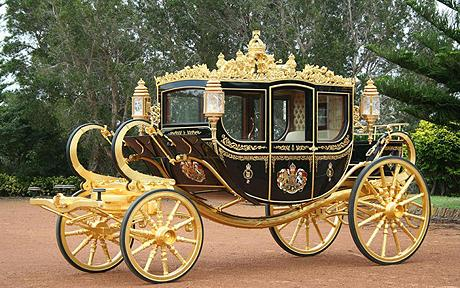
A coach-cam giving Her Majesty 360-degree views is hidden in a gold-leaf covered crown made from timbers of Lord Horatio Nelson’s ship Victory. There’s polished wood from the very apple tree that dropped an apple on Newton’s head (while he was lying low in a pandemic!); wood from a Bronze Age boat, a Waterloo musket ball. Yew from Glamis Castle in Scotland where the Queen Mother grew up, ash from Blenheim Palace, oak from Althorp – ancestral home of the Spencer family. A bolt from a Spitfire, metalwork from a Hurricane and a Lancaster.
The Queen sits on a part of Scotland’s Stone of Destiny, on which monarchs are crowned. The panelling includes some of Scott’s Antarctic sled, Hut Six at code breaking centre Bletchley Park, one of Sir Edmund Hillary’s Everest ladders and wood from the beams of most of the UK’s great cathedrals.
There’s a button from Gallipoli. Part of the bronze cannon all Victoria Crosses are made from. A piece of metal from the wreckage of a 617 Squadron Dambuster. Door handles encrusted with real diamonds and Australian sapphires; made by a jeweller. Loads of real gold – including gold plated hydraulic suspension. The Rose, Shamrock, Leek and Thistle are inside decor. English leather upholstery. Best lead crystal lamps. Electric windows. Ducted heating from a diesel unit under the seat. Richard the Lionheart’s leopards decorate one compartment. The arm rests flip up to reveal Bond-style heating and electric window controls, and are made from parts of the old Royal yacht. And more, more, more.
Jim Frecklingham of Sydney, trained in coach buildiing, wanted to make this coach for the Queen’s 80th birthday. He began building in the year 2000, in a shed at Manly. An expensive undertaking – time got away and the birthday passed. Generous donations however saw it completed and shipped to the UK for the Diamond Jubilee in 2014.
A Sydney drag racer, Terry Sainty, designed the spokes to throw mud and manure away from the coach – they’re constructed from light aero-grade aluminium used in drag racing; he also made the rims and rest of the wheels. The Duke suggested polyurethene coating on the gold plated wheels – perfect. Jim after all, knew him when he used to care for his four in hand team. Exquisitely painted Royal Arms on the doors.
