
War Animals

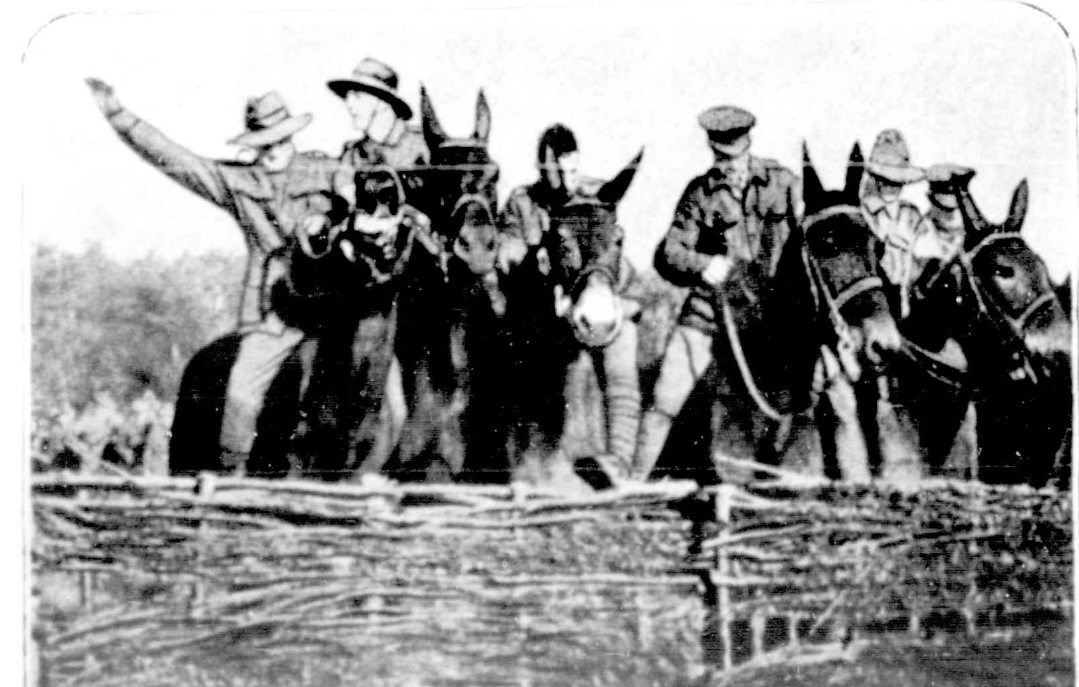
Waler Data Base @ Facebook. Image: A unanimous refusal by the mules in a hurdle race at an ANZAC Horse Show at the front. The Australasian, 9th February 1918
Thank you to the people and animals that served. Our horses showed why they were among the world’s best, in Europe, in the Middle East. They did our men proud, and our men did them proud. They did not come home. We will never forget them.
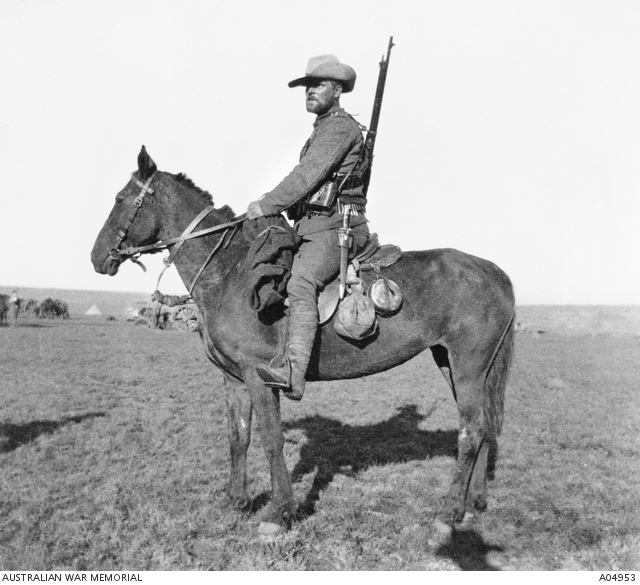
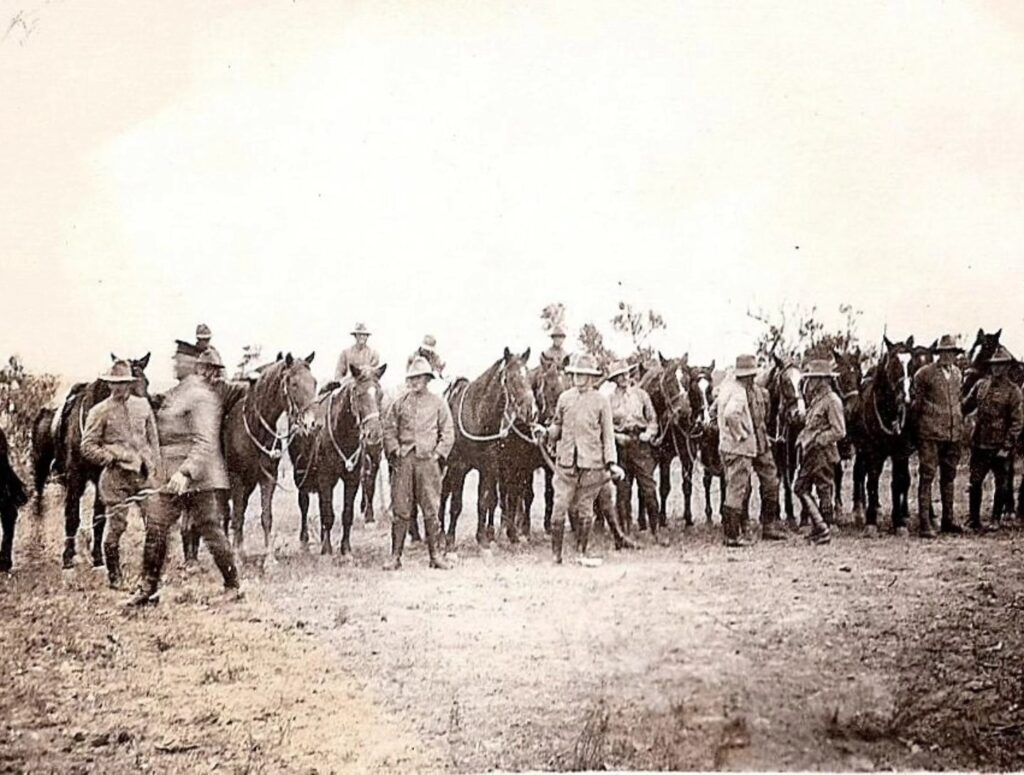
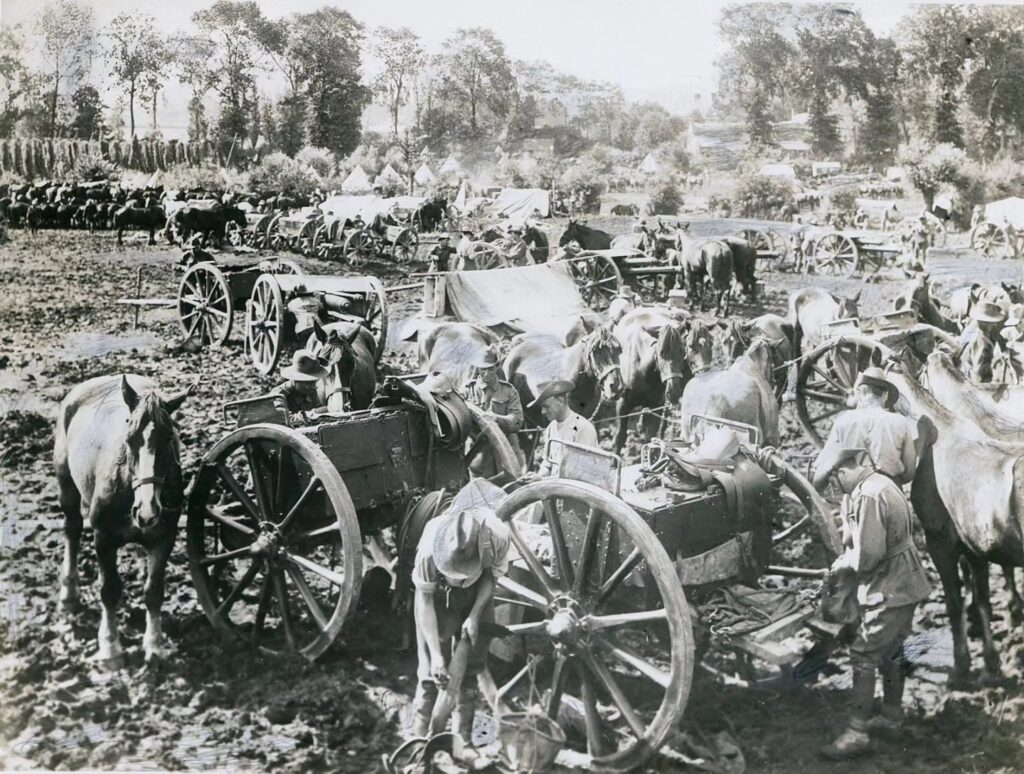
Images: During WW1, horses were suited to different military roles. Riding horses were used in the cavalry and as officers’ mounts. Draught horses switched from pulling buses to hauling heavy artillery guns or supply wagons. For example, the main British artillery weapon of the war – the 18-pounder – could be quickly maneuvered around the battlefield with a crew of ten men and six horses. By 1917, the British Army (including Empire and Dominion units) employed over 368,000 horses on the Western Front. The vast majority of these were draught or pack animals rather than cavalry horses. Over 130,000 Australian horses were shipped overseas for war service. Army Museum of Western Australia
Australian War Memorial photo shows a Memorial Drinking Trough, 1914-1918, erected in St Kilda Road, Melbourne by the Purple Cross Service of Victoria and unveiled on 10 May 1926 by Lieutenant General Sir John Monash GCMG KCB VD.
Lines of verse on the tablet read:
“He gains no crosses as a soldier may
No medals for the many tasks he runs
He only in his puzzled, patient way
Sticks to his guns.” ‘
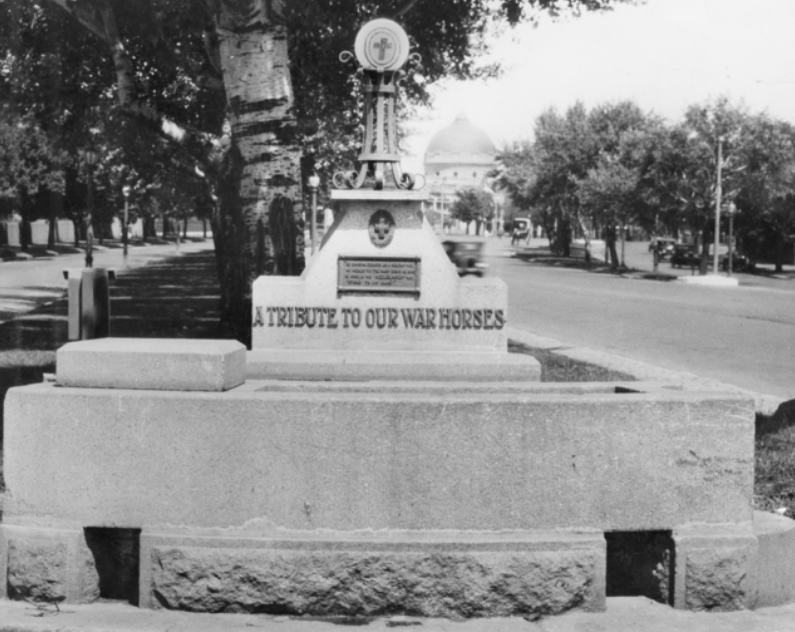
As well as funding everything from horse ambulances, feed and vet supplies to stables being built for horses in the war theatre, funds raised by the Purple Cross paid for this memorial watering trough. Built after the war, when funds no longer needed for war.
There were many horses working in the city so this would have been most welcome. Being in Melbourne, the capital city of the state of Victoria, it was paid for by funds raised by the Victorian group of the Purple Cross Service.
To be noted the Purple Cross, as many know, raised funds not just for horses, donkeys and camels but all animals and pigeons used in war. Dogs benefited from the medical supplies provided. There was also a Blue Cross service doing much the same good – raising funds for our animals at war; they too did an outstanding job both in the UK and Australia.
Kiss Lass, the little pit pony, we could say, provided welcome water for her working comrades of the city.
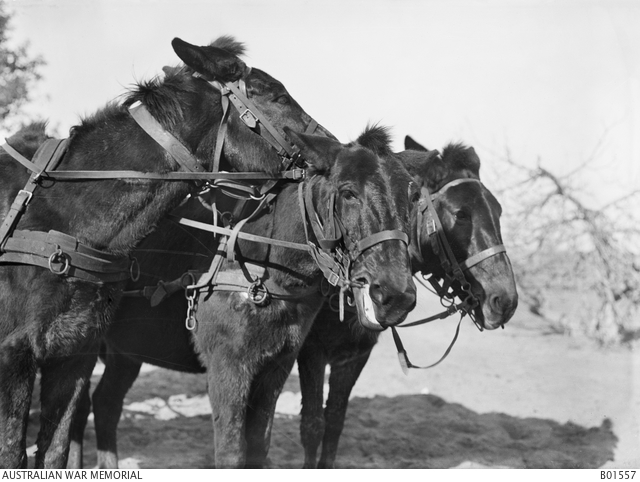
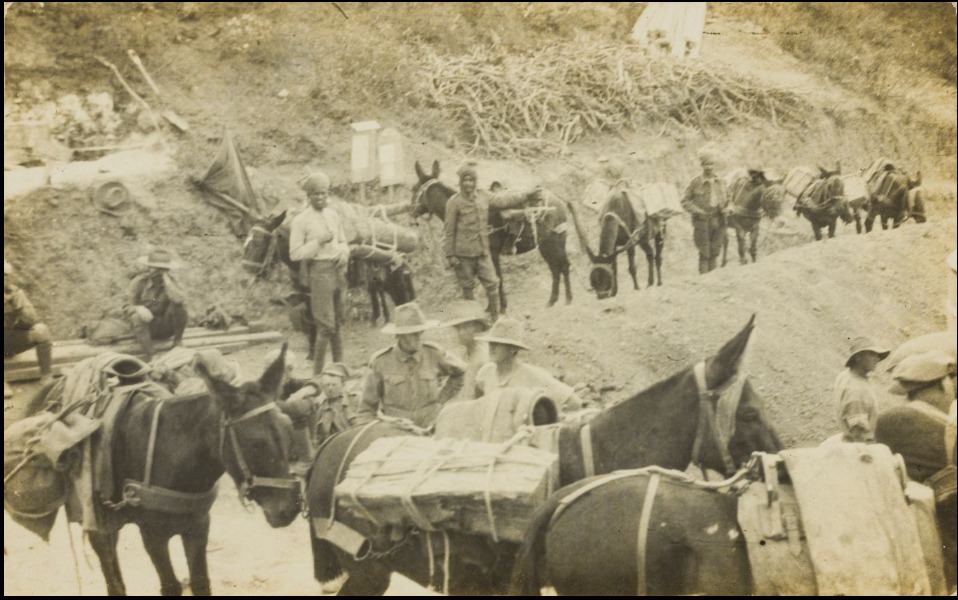
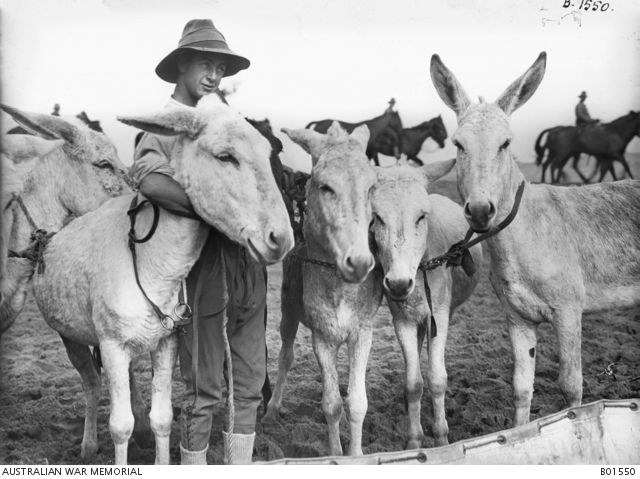
Images: A study on three mules in the desert. Frank Hurley 1915 Egypt, AWM; Mule transport carrying wood, water and stores, Gallipoli Peninsula, 1915, State Library Qld.
The mules were mostly under the Indian army there, also Palestinian and Egyptians in other areas who were helping us, attached to several L.H. regiments, primarily used for stores, water and horse feed. Many donkeys also under care of locals helped us.
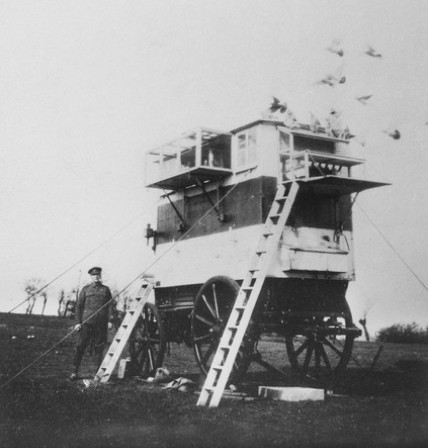
‘St. Gratien, France, 1918. A mobile pigeon loft probably operated by the 2nd Divisional Signals Company, 1st AIF, standing in a field northeast of Amiens.
A member of the unit is standing beside the loft at left, while at right a number of pigeons are taking to the air above the vehicle. The loft was used to house and transport carrier pigeons.’ AWM
These pigeon lofts were horse drawn. Most were made from omnibuses.
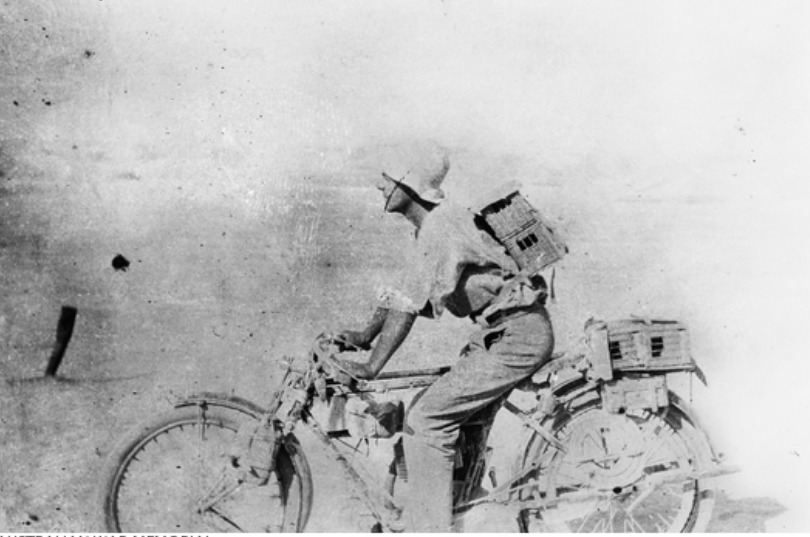
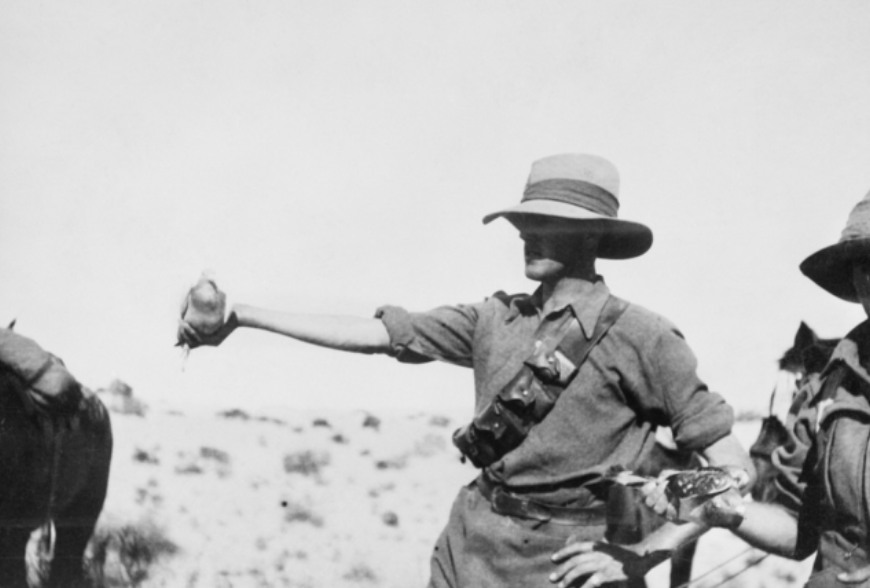
AWM images: A motor cyclist transporting carrier pigeons in small cages, September 1918 at Wadi Mellahah, Jordan Valley; An Australian Light Horse trooper about to release a carrier pigeon. Palestine 1915.
‘”Simpson” … his real name was John Simpson Kirkpatrick, and he enlisted in Western Australia, but eh was a native of South Shields, England. With two donkeys, Duffy No.1 and Duffy No 2. he carried many wounded from the firing line to the beach until at last he was killed.’
Sydney Mail, 26th April 1915
In articles of the time, it was said Duffy 1 and Duffy 2 had been caught from the Turks. Later (1919) accounts say Simpson had one donkey named Murphy, which had a female mate and a foal, the last two being shot on Gallipoli. Perhaps he used several donkeys, someone may know.
The main thing is he had incredible courage and so did the little donkeys. He usually put the Red Cross on his donkey’s forehead.
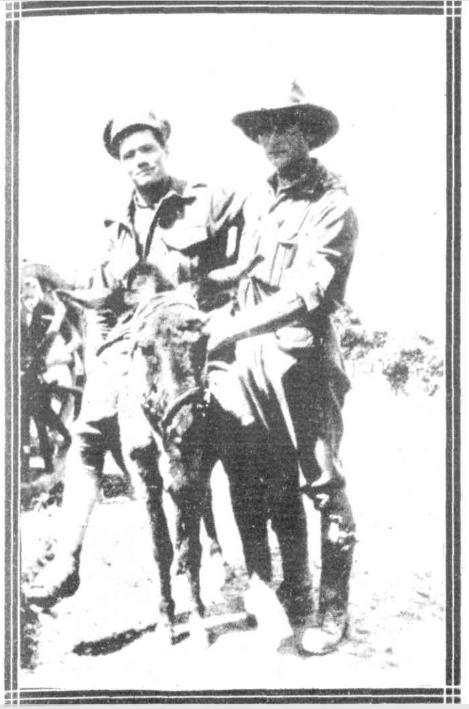

‘Duffy2.’
‘When Simpson heard that on the ANZACS left flank 2000 Turks and about 400 donkeys had been captured, he went along to investigate, with the result that the 3rd Field Ambulance, to which he belonged, was strengthened by two donkeys, which their master christened “Duffy No.1” and “Duffy No. 2.”
The latter was killed by a stray Turkish bullet, but “Duffy No. 1” continues his good work until the noble career of Simpson himself was ended.’
Sydney Mail, 26th April 1915
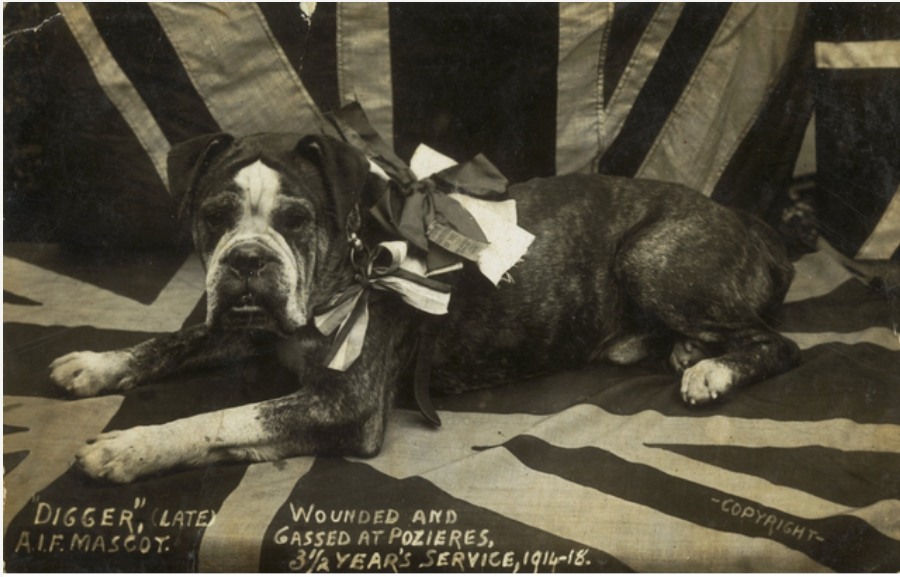
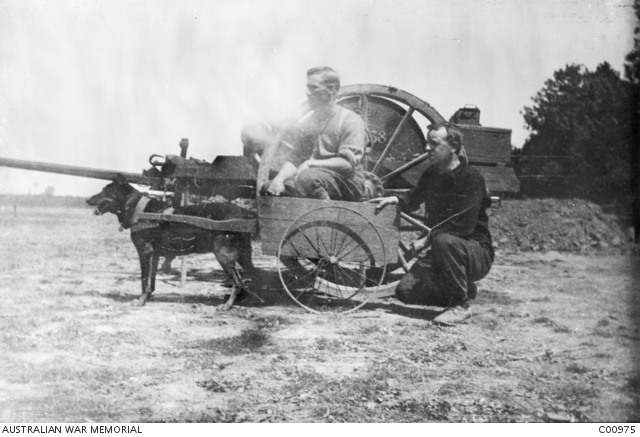
‘A German message dog captured by the 13th Battalion near Villers-Bretonneux on 3 May 1918. The two soldiers in and behind the dog cart are Corporal Green and Private Martin. The dog was sent as a ‘trophy’ to Southampton en route to Australia. He was originally called ‘Roff’, but the Australians changed his name to ‘Digger’. Roff’s stuffed and mounted skin is in the Australian War Memorial’s collection. 3rd May 1919.’ AWM
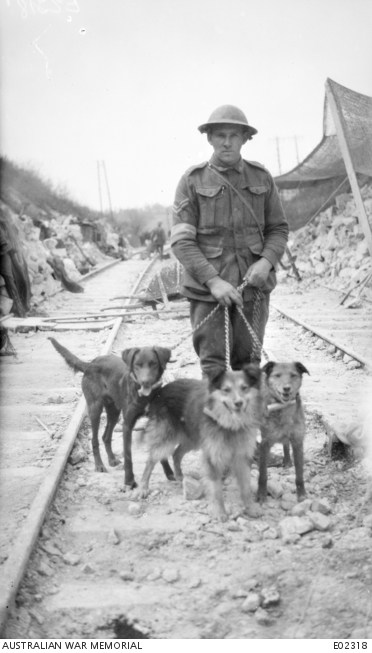
‘Informal portrait of 3133 Corporal James Coull, in charge, with dogs of No. 3 Messenger Dog Section, attached to the 4th Divisional Signal Company, in a railway cutting near Villers-Bretonneux while operating with 12th Brigade. Section comprised sixteen men and fifty messenger dogs. These dogs worked with fairly successful results but were never solely relied on in sending messages. Left to right: War Dog 103 Nell, a Cross Setter; 102 Trick, a Collie; 101 Buller (sometimes referred to as Bullet), an Airedale. All three dogs were very efficient in message carrying and saw service with the 2nd, 4th and 5th Australian Divisions, also with Divisions of the British 8th Corps (Imperial). 102 Trick was particularly efficient and was well known by all Brigades of abovenamed Divisions. He was specially mentioned by Signal Officer of 2nd Division for good work at Rubimont, near Heilly. France: Picardie, Somme, Amiens Harbonnieres Area, Villers-Bretonneux Area, Villers-Bretonneux. 3rd May 1918.’ AWM
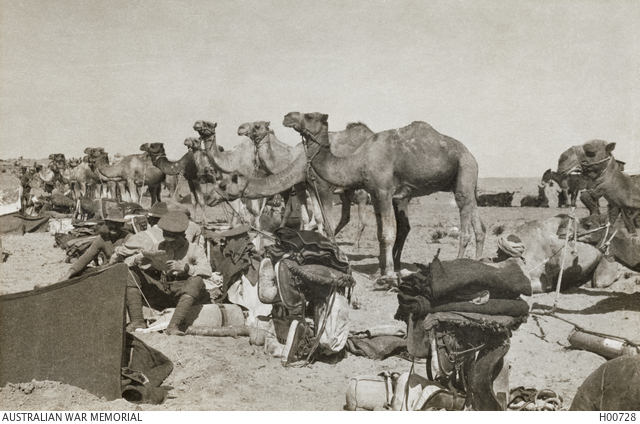
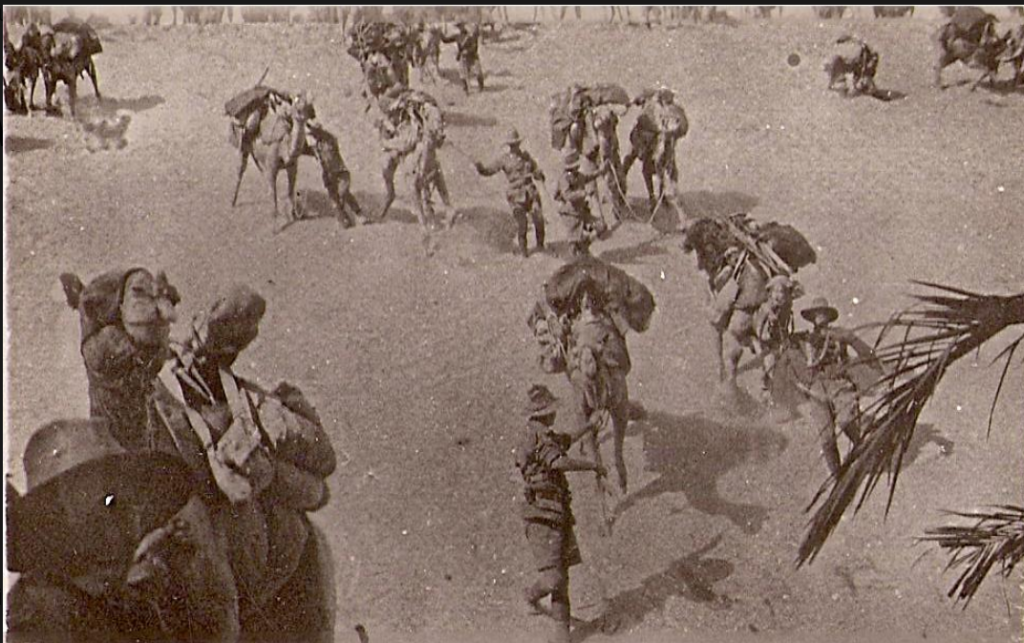
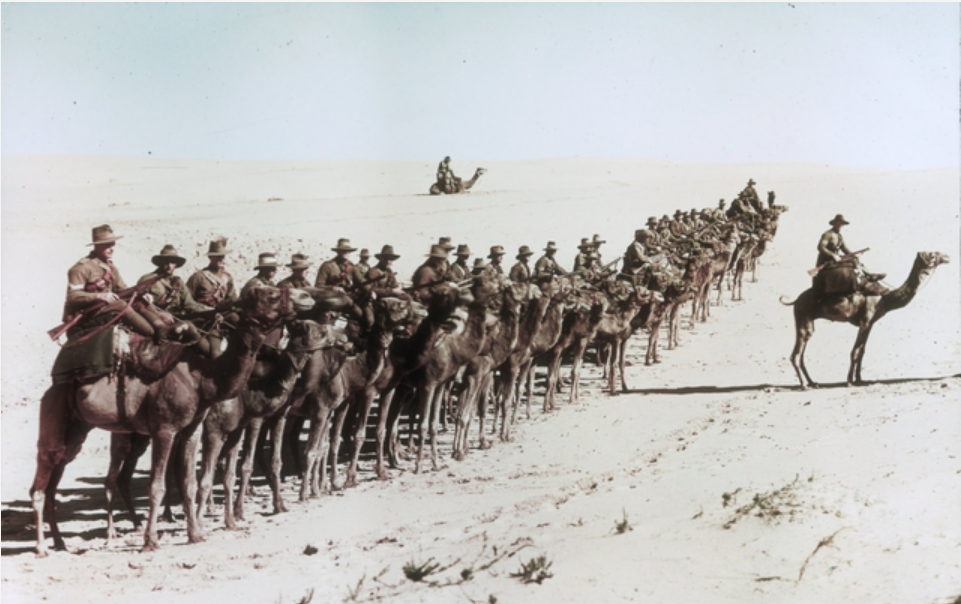
Images: ‘Loaded camels being led down a sandbank. World War 1, Middle East, Imperial Camel Corps, 1918.’ Australian Army Museum of Western Australia via Collections WA; Australians of the Imperial Camel Corps on the sandhills. This image is a colour Paget Plate. Frotier, Rafa, Sinai, Egypt. 26th January 1918.’ Frank Hurley photo, AWM
